 Loops House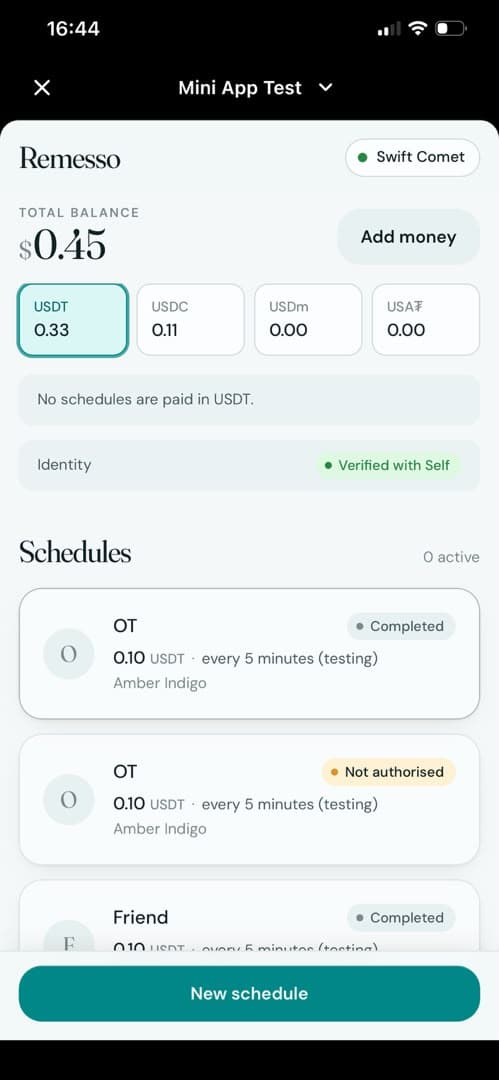

Remesso
Send money home on a schedule, in the currency your family spends — signed once, carried out by an agent on Celo.

Agents on Open Rails Hackathon
Links
Team
1 member- EAOwner
Eagle
Overview
Remesso
Send money home on a schedule, in the currency your family spends — signed once, carried out by an agent on Celo.
Live on Celo mainnet · App: https://remesso.crackedstudios.xyz · Demo video: https://youtu.be/ojKpB09juTA · Repo: https://github.com/crackedstudio/Remesso
Hackathon tracks
Agents on Open Rails (Loops House × Celo) — Remesso is entered in two tracks:
| Track | Bounties | Why Remesso fits |
|---|---|---|
| Stable Agents: LatAm (Ripio × Celo) | 1st and 2nd place | Remittances to Argentina, Brazil and Colombia paid in Ripio's wARS, wBRL and wCOP by an agent on Celo mainnet — no conversion through dollars — with Ripio's ramp to buy and cash out, and two paid services, latam-rate and latam-route, that price and route peso and real payments. |
| Open Corridors: USA₮ with x402 | 1st and 2nd place | Four services sold over x402 through Celo's facilitator, priced in USA₮ (also USDC and USD₮), a published agent skill that pays in USA₮ by default, and USA₮ as a schedule currency — in a browser wallet and in MiniPay. |
The problem
Families split across borders pay each other on a rhythm — school fees every term, rent every month, a parent's allowance every week. Today that is a chore repeated by hand, and for Argentina, Brazil or Colombia it usually means converting through dollars and paying a spread at each step. Automating it normally means handing a company custody of the money or a card on file.
What Remesso is
A sender signs one on-chain mandate: who gets paid, how much, how often and until when. From then on Remesso's agent carries it out on Celo mainnet — every week or every month — without asking again.
The agent can only do what was signed. The mandate lives in our contract,
RemessoExecutorV4 (0x288b7cDD10e069eA64D4984c3E5fa0D9c5816009, verified),
and nobody — not the agent, not us, not the contract owner — can redirect,
resize or extend a payment. The sender can pause, resume or cancel at any
time from their wallet. Money never sits with us: each payment moves straight
from the sender's wallet to the recipient's, through an allowance the sender
grants and can revoke.
How a payment happens:
- The sender approves the token and calls
createSchedule— two transactions in their own wallet. - Every 5 minutes,
sync-schedulesfinds new schedules on-chain, including ones created outside the app (by a script or another agent). - Every minute,
execute-due-runschecks which schedules are due, readsrunnability()on-chain (due, funded, approved), and the agent wallet callsexecuteRun. - The contract moves the amount — minus a 0.25% fee, fixed at signing — to the recipient, and the app shows the receipt.
The agent
| Agent wallet (sends every payment) | 0x3c754AD31e802D5fA65487f460dED65Aba749Cd1 |
| ERC-8004 identity held by the agent wallet | agent #9879 (registry 0x8004A169FB4a3325136EB29fA0ceB6D2e539a432) |
| ERC-8004 identity held by the owner | agent #9867 |
| Proof of a human behind it | Self Agent ID #191 — soulbound, zero-knowledge passport proof |
| Capabilities (machine-readable, free) | GET https://engaboljiqudghvzmebq.supabase.co/functions/v1/agent |
| Agent card | https://remesso.crackedstudios.xyz/.well-known/agent.json |
What the agent decides — the pre-flight check
Sending a payment that is due is the deterministic part, and should be: the contract decides whether it may go. The judgement is in what comes before it. Every 30 minutes, for each payment due in the next day, the agent runs a loop:
- Observe: it reads from Celo mainnet the sender's balance of the payout token and how much they have allowed Remesso to move. For a peso or real payment it also reads the live Uniswap rate and compares it with its own reading from a day earlier.
- Decide: it works out whether this payment will be skipped and why (no money, or no permission), whether the payment after it will be, and whether a peso payment's dollar value has moved by 3% (info) or 8% (warning). A shortfall becomes urgent inside six hours.
- Act: it posts a notice in the sender's app that says by how much the payment falls short, with the fix attached: "Add money" in MiniPay, or "Allow payments again".
- Verify: on every later pass it checks again and closes its own notice once the sender has fixed the problem, or when the schedule is cancelled on-chain.
The result is that a payment gets fixed before it is due, rather than failing
and being explained afterwards. The agent advises and never touches the money
path. The decision rules are a pure function pinned by tests
(supabase/functions/_shared/preflight.ts), and the words a sender reads are
written in code, not by a model. It reads rates from the same sources as our
paid latam-rate service, but does not buy from its own x402 endpoint: paying
ourselves would put circular volume on our own payTo.
Every transaction Remesso causes — each payment the agent sends and each
transaction a sender signs in the app — carries an ERC-8021 attribution suffix
with both remesso and our hackathon code celo_5cd35ca55baf, pinned
byte-for-byte to @celo/attribution-tags by a test.
Tokens we support
All on Celo mainnet. The contract's own allowlist decides what a new schedule may use; the app and the agent document read that allowlist rather than a list of ours, so nothing is offered before the contract accepts it.
| Token | Currency | Address | Decimals | In MiniPay | In a browser wallet | x402 |
|---|---|---|---|---|---|---|
| USD₮ (USDT) | US dollar | 0x48065fbBE25f71C9282ddf5e1cD6D6A887483D5e | 6 | ✅ | ✅ | ✅ |
| USDC | US dollar | 0xcebA9300f2b948710d2653dD7B07f33A8B32118C | 6 | ✅ | ✅ | ✅ |
| USDm (formerly cUSD) | US dollar | 0x765DE816845861e75A25fCA122bb6898B8B1282a | 18 | ✅ | ✅ | — |
| USA₮ | US dollar | 0xD2ab3C9A02DBBAB236BfEC45D1d755DF4267F771 | 6 | ✅ | ✅ | ✅ (default) |
| wARS (Ripio) | Argentine peso | 0x0DC4F92879B7670e5f4e4e6e3c801D229129D90D | 18 | — | ✅ | — |
| wBRL (Ripio) | Brazilian real | 0xD76f5Faf6888e24D9F04Bf92a0c8B921FE4390e0 | 18 | — | ✅ | — |
| wCOP (Ripio) | Colombian peso | 0x8a1D45e102e886510e891d2Ec656a708991e2D76 | 18 | — | ✅ | — |
Schedules use the Direct rail: the recipient receives exactly the token the sender funds with. No swap, no conversion, no price risk. A peso schedule pays pesos; a USA₮ schedule pays USA₮.
A peso is not a dollar, and code written for dollar stablecoins assumed it was. We scaled the backend's per-payment safety cap per currency (rounded so it only ever gets stricter), count only dollar tokens in balance totals and in the unusual-payment check, and made the backend refuse any token it does not know rather than guess its decimals.
MiniPay integration
Remesso runs inside MiniPay as a Mini App, built to MiniPay's own rules.
- Connects by itself. MiniPay is detected and the wallet connects automatically — no connect button, no wallet picker.
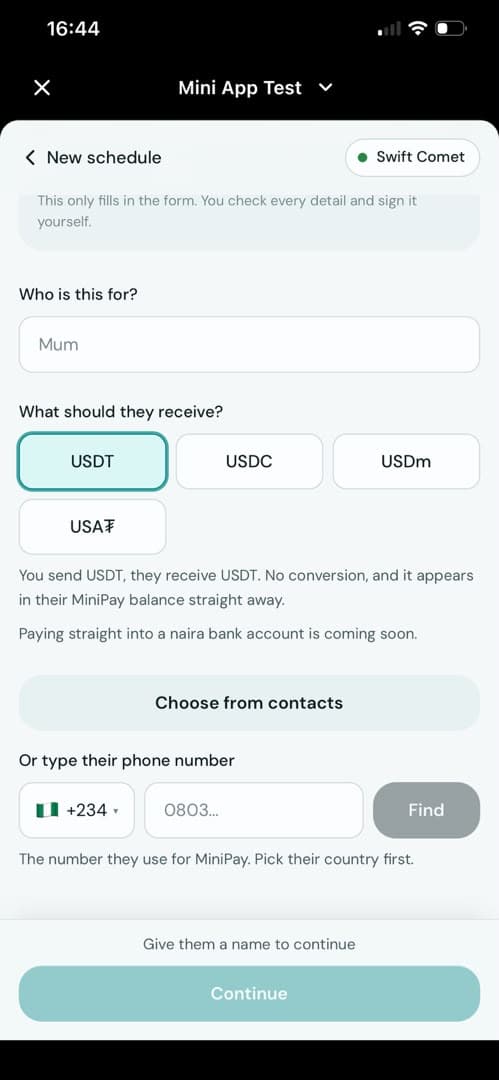
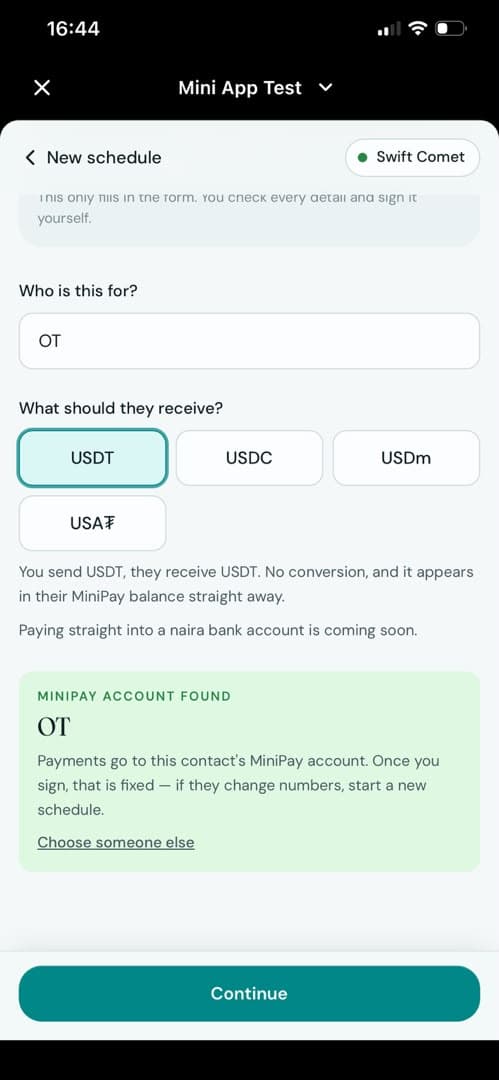
- Pay a contact. "Choose from contacts" opens MiniPay's own contact
picker (
minipay_requestContact). MiniPay matches the contact to their MiniPay wallet on the device, so no phone number ever reaches us, and the contact's name fills "Who is this for?". - Or type a phone number — never an address. MiniPay forbids typing,
pasting or displaying wallet addresses, so inside MiniPay the recipient is a
phone number. A country picker with all 245 countries (Nigeria, Ghana,
Kenya, South Africa, Uganda, Tanzania, Cameroon and Ethiopia first; the last
choice remembered) lets people type numbers the local way —
0706 765 1245in Nigeria becomes+234 706 765 1245. No country is ever guessed. - Phone → wallet through Celo's identity layer. Our server resolves the
number with ODIS and FederatedAttestations, trusting only MiniPay's
own attestation issuer (
0x7888…7FBc), so a number maps to the MiniPay account its owner registered. Only a masked number is stored (+234 706 ••• 1245); the full number is stored and logged nowhere. Lookups are metered at 20 per user per day, because each one is paid and reveals whose wallet a number is. If a number has no MiniPay account, the form offers a WhatsApp invite instead. - No address on screen, anywhere. Inside MiniPay a recipient is shown by name or masked number — never an address, truncated or not.
- MiniPay's tokens only. Inside MiniPay we offer exactly the four MiniPay supports — USDT, USDC, USDm and USA₮ (added the day MiniPay's own deposit screen listed it) — and call USDm by MiniPay's name for it.
- The assistant understands numbers too. "Send 20 USDT to +234 803 123
4567 every month" fills the whole form. The phone number is cut out in the
browser before the sentence goes to the language model — the model sees
[recipient], never a person's number — and then looked up exactly as if typed.
Status: built and tested through MiniPay's developer mode. Remesso is not yet a listed Mini App, so ordinary MiniPay users cannot open it until MiniPay approves it; that submission is our next step.
Web integration
In any browser with a Celo wallet (MetaMask, Valora, Rabby…), Remesso offers everything MiniPay's rules leave out.
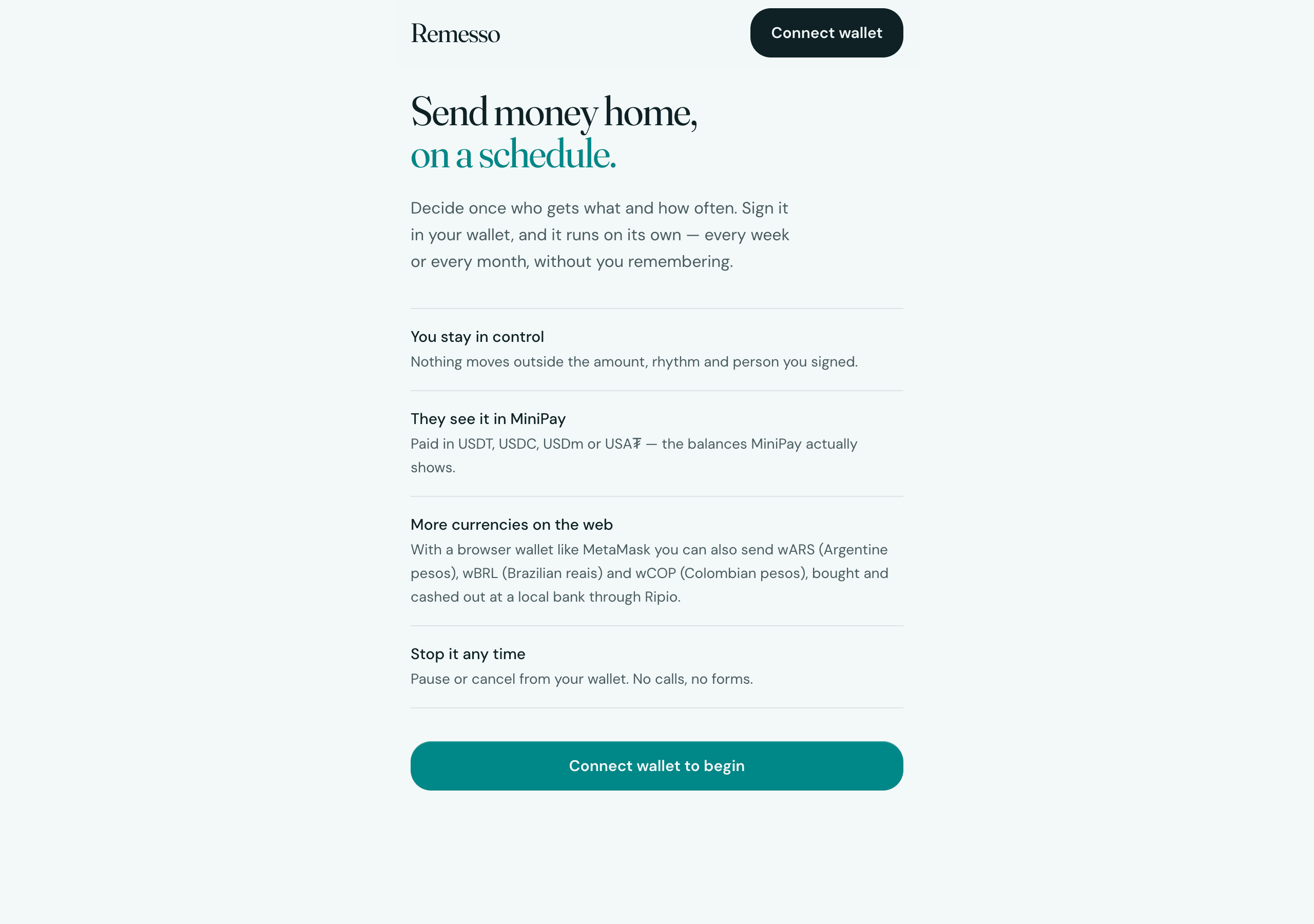
- All seven tokens, including USA₮ and Ripio's pesos and reais. The landing page tells visitors so, with the list read live from the contract.
- Ripio on- and off-ramp. Choosing wARS, wBRL or wCOP shows "Buy it with Ripio" (from a local bank account) and "Cash out at Ripio", prefilled with country, Celo, token and wallet. We also bought wARS on Celo itself, through Uniswap's 0.01% USDT/wARS pool.
- Wallet addresses, typed or pasted, with a copy button on each schedule.
- Pay links.
/schedules/new?to=…&amount=…&token=…&every=…opens a prefilled form; the form says a link filled it in, and the sender still reviews and signs every field. Our invite links are built this way. - Payment requests. Anyone — a person or an agent — can ask to be paid on a
schedule (
POST /functions/v1/request-payment, free); the request appears on the payer's home screen as a prefilled form. It can never create a payment. - "Or just say it". Describe the payment in a sentence and the form fills in. Every field is shown for review before signing; ambiguous readings are flagged, and an unusual schedule (amount, rhythm, new recipient) gets a warning before it is signed.
- Schedule pages with the next payment countdown, pause, resume and cancel, the full payment history, and — when the sender allows it — who may send a payment early.
- Optional identity check with Self (passport, 18+, sanctions list) shown as a badge; it never gates a payment.
x402 integration
Remesso sells four services to other agents over x402, through Celo's
facilitator (https://api.x402.celo.org). The paying agent signs a token
authorisation; the facilitator submits it and pays the gas, so the payer needs
no CELO.
| Service | Endpoint | Price | What it does |
|---|---|---|---|
naira-rate | POST /functions/v1/rate-service | 0.001 | Live USDT/NGN and USDC/NGN — bid, ask, last; mid and spread only when both sides are quoted (never invented) |
latam-rate | POST /functions/v1/latam-rate | 0.001 | USD-to-wARS and USD-to-wBRL from two independent on-chain sources side by side — Textile's RFQ makers and the Uniswap pool on Celo at your size, with price impact — flagged when they disagree by more than 1%. wCOP: "no on-chain market on Celo", never priced from elsewhere |
latam-route | POST /functions/v1/latam-route | 0.002 | How to deliver pesos or reais: the token, the dollars it takes and the best venue at that size, Ripio's buy and cash-out links and a prefilled Remesso schedule link. Moves nothing |
trigger-run | POST /functions/v1/trigger-run | 0.01 | Brings one payment of a schedule forward, only if its sender allowed early sends |
- Currencies: USDC, USD₮ and USA₮, at the same price in each (all 6dp).
- Paid to (payTo):
0xcDEA4Cc4191Ec9A5d8fD1a6B17e3F4C84E993Ae2— the same on every service and every currency, confirmed from the live 402s. - How x402 activity is credited. Attribution tags are not yet supported on
x402 settlements, so the hackathon credits x402 by this payTo address. It is
also Remesso's owner wallet and receives the 0.25% schedule commission, so
x402 payments are the ones Celo's facilitator (
0x0d74D5Ce…FB48) submits astransferWithAuthorization. Every one to date is our own test (listed under Proof on mainnet). - x402 v2 on the wire, v1 still accepted: the price list rides in the
PAYMENT-REQUIREDheader, the payment inPAYMENT-SIGNATURE, the receipt inPAYMENT-RESPONSE. We moved to v2 after measuring that the official@x402/fetchrefused v1 sellers — every agent using the standard SDK could not have paid us. - Built on Textile's quotes.
naira-rate,latam-rateandlatam-routeread Textile FX's live maker quotes (api.textilecredit.com/tickers), and the pre-flight agent falls back to them when the Uniswap pool cannot answer. So we can honestly say Remesso is built on Textile's quotes. We use them as prices, never as a payment route. Every answer sets Textile beside the Uniswap pool, because a maker can stop quoting one side and Textile has no wCOP pair. - The LatAm services read the market, not a table. On live data, 20,000
ARS costs about $12.48 of USDT through the Uniswap pool; at $5,000 the wBRL
pool loses 1.2% to price impact, so
latam-routepicks Textile's makers instead andlatam-rateflags the split. Ripio is linked, not integrated — its public ramp, no partnership implied. - Nobody pays for a failure.
trigger-runchecks the schedule on-chain and answers 403 before quoting a price if the call could not succeed; the order is verify → run → settle, so a payment that reverts charges nothing (409). - Builder code, ready for when tags arrive. Every 402 already declares the
x402
builder-codeextension ({"a":"remesso","s":["celo_5cd35ca55baf"]}), verified identical to@x402/extensions, so settlements will carry our tag once Celo's facilitator supports it. Until then, payTo is what counts. - Verified with the official client.
@x402/fetch+@x402/evm2.28.0 at default settings paid our endpoint in USA₮ on mainnet — USA₮ is inside the SDK's default spend controls on Celo, so agents need no extra configuration.
Agent skills
Two skills, installable by any agent with one command:
npx skills add crackedstudio/Remesso --skill remesso-x402 # pay our x402 servicesnpx skills add crackedstudio/Remesso --skill remesso # schedules, being paid, the contractremesso-x402 pays in USA₮ by default. It installs:
-
SKILL.md— the services, payment terms, a code sample and the mistakes that cost money on Celo (fee adapters that share a token's symbol, EIP-712 names that are not the symbol, v2 headers). -
scripts/pay.mjs— a ready-to-run payer on the official x402 client:bashnpm i @x402/fetch@2.28.0 @x402/evm@2.28.0 viemPAYER_KEY=0x… node scripts/pay.mjs --service naira-rate # pays in USA₮PAYER_KEY=0x… node scripts/pay.mjs --service latam-rate --body '{"usd":250}'PAYER_KEY=0x… node scripts/pay.mjs --service latam-route --body '{"country":"AR","amount":20000}'PAYER_KEY=0x… node scripts/pay.mjs --service naira-rate --asset USDC # opt out of USA₮It chooses the token by address, refuses any quote above
--max(default 0.05) before signing, and stops before signing if the wallet holds no USA₮, saying how to pay in USDC or USD₮ instead. -
manifest.json— the payment terms as data: networkeip155:42220, payee, facilitator,defaultAsset= USA₮, each token's address, decimals and EIP-712 domain, and all four services with their prices. It is generated from the live 402, never typed by hand, and--checkfails if it drifts. An index of both skills (skills/manifest.json) and a JSON Schema for the format (skills/manifest.schema.json) sit beside it.
The skills are also served from the app (/skills/manifest.json,
/skill.md) and linked from the agent card.
Proof on mainnet
All of these are our own test transactions. Remesso has no independent users yet, and we do not count any of the payments below as volume.
| What | Transaction |
|---|---|
| wARS, wBRL, wCOP allowed on the contract (2026-10-06) | 0x717cc22c…, 0x482172a7…, 0xbed93797… |
| USA₮ allowed on the contract (2026-10-11) | 0xf3292694…9e5a |
| ERC-8004 agent #9879 registered from the agent wallet | 0xc806f21d…bad5 |
| First peso payment by the agent: a 1,000 wARS weekly schedule created outside the app was found and paid within 5 minutes, unprompted — 997.5 wARS to the recipient, 2.5 wARS fee | 0x4eaf6976…9cdc |
| x402 payments in USA₮ through the official SDK (run twice) | 0x084c5027…ab39, 0x5780ab21…d38d |
x402 payment in USA₮ through the remesso-x402 skill script | 0xf91d3465…d6f9, 0x15167882…d6f8 |
latam-rate and latam-route paid in USA₮ through the skill script | 0x24d0ea8d…713a, 0x86706193…d328 |
An outside developer installed remesso-x402 from GitHub and paid in USA₮ on their own — with test funds we provided | 0xa5d6eceb…aca2 |
What we built during the hackathon (from 2026-10-06)
- Ripio's wARS, wBRL and wCOP, then USA₮, on the live contract's allowlist; the form and agent document read the allowlist from the chain.
- Ripio buy and cash-out links; per-currency safety caps and totals.
- Attribution on every transaction with both codes; the x402 builder-code extension.
- ERC-8004 agent #9879 held by the agent wallet.
- MiniPay: contact picker, phone numbers through ODIS with a 245-country picker, no addresses on screen, MiniPay's four tokens only (USA₮ included), USDm naming, phone numbers kept away from the AI model.
- Web: every token on the landing page and the form, read from the contract.
- x402 v2 verified with the official SDK in USA₮.
- Two new paid services,
latam-rateandlatam-route, for pricing and routing peso and real remittances on Celo — a bad request is refused before any price is quoted, and a source outage charges nothing. - The public agent document corrected to say x402 v2 (it still said v1) and listing all four paid services.
- The
remesso-x402skill, its script and its generated manifest, USA₮ by default. - The pre-flight agent: observe, decide, act and verify on every upcoming payment, with notices in the app that carry their own fix.