 Loops House


Links
Team
1 member- YEOwner
Yemi Graffix
Overview
MOI - Autonomous Treasury Operating System
Across emerging markets and globally distributed economies, modern digital businesses operate across two conflicting financial realities: they earn revenue in volatile local fiat currencies like the Nigerian Naira (cNGN), but they are required to settle global operational expenses, cross-border vendor commitments, cloud infrastructure, and software subscriptions in US Dollars. Managing these treasury flows manually is inherently inefficient, capital-intensive, and prone to human error. Treasuries are forced to constantly track reserve balances, manually execute conversions through decentralized pools with unpredictable slippage, and absorb overnight currency devaluation that steadily erodes operational cash reserves.
While the natural evolution of financial technology points toward autonomous artificial intelligence delegating balance monitoring, drift calculation, and automated FX rebalancing to software that operates at machine speed the blockchain industry has hit a fundamental trust barrier. Language models hallucinate, suffer from prompt injection, and lack deterministic boundaries. Giving an autonomous AI agent direct, unrestricted access to raw treasury private keys is an existential security hazard that no serious enterprise or finance team can afford.
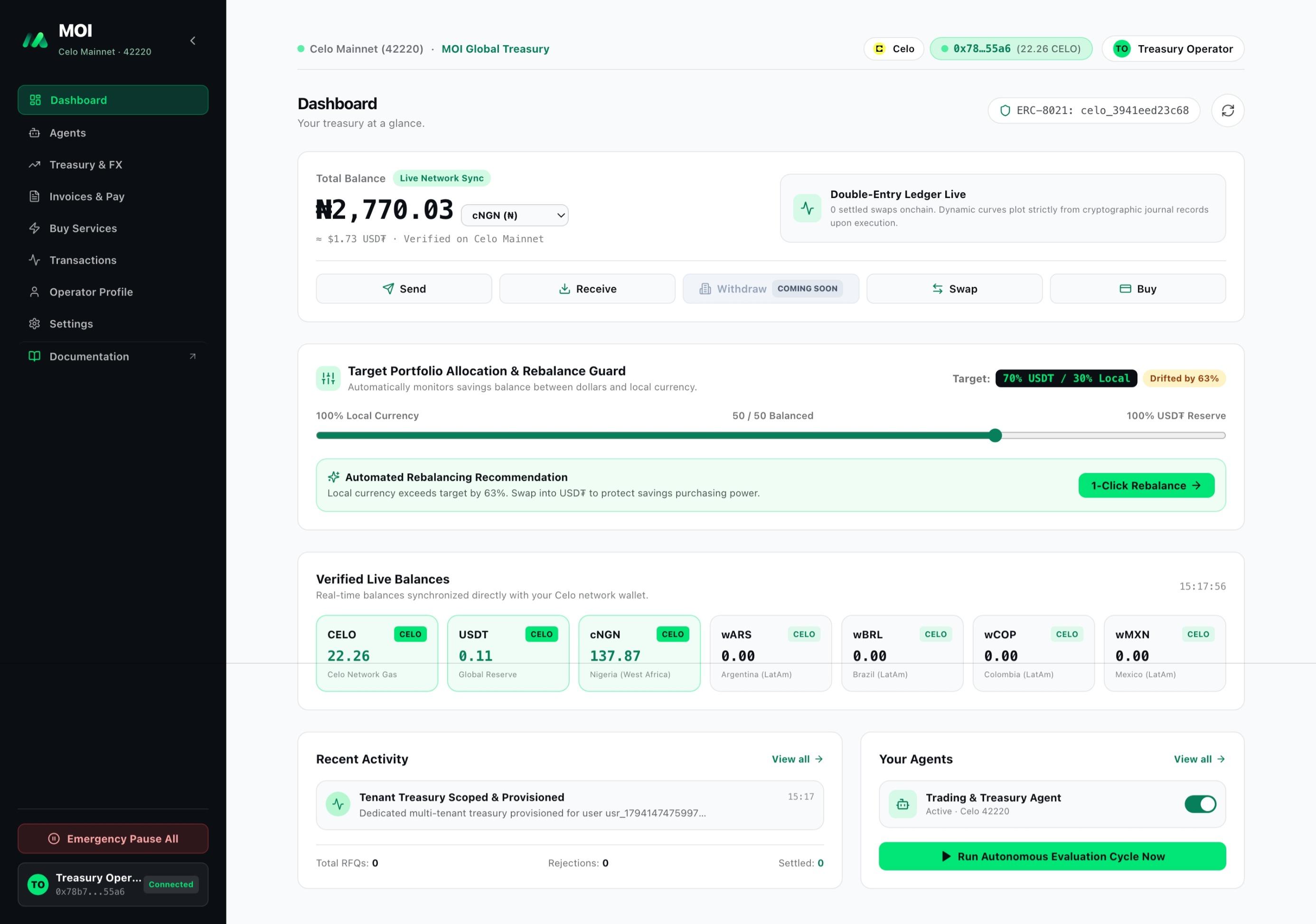
MOI was engineered to resolve this dilemma by pioneering the concept of deterministic Spending Mandates on Celo Mainnet. Built entirely around the architectural principle that "AI proposes, MOI enforces, the user controls, and execution infrastructure settles," MOI eliminates custody risk by keeping treasury funds strictly inside the business’s non-custodial wallet. Instead of granting an agent signing authority over raw capital, the treasury owner defines an immutable cryptographic mandate that establishes strict mathematical guardrails: per-trade spending caps, rolling 24-hour velocity ceilings, non-negotiable operational reserve floors, and whitelisted currency corridors.
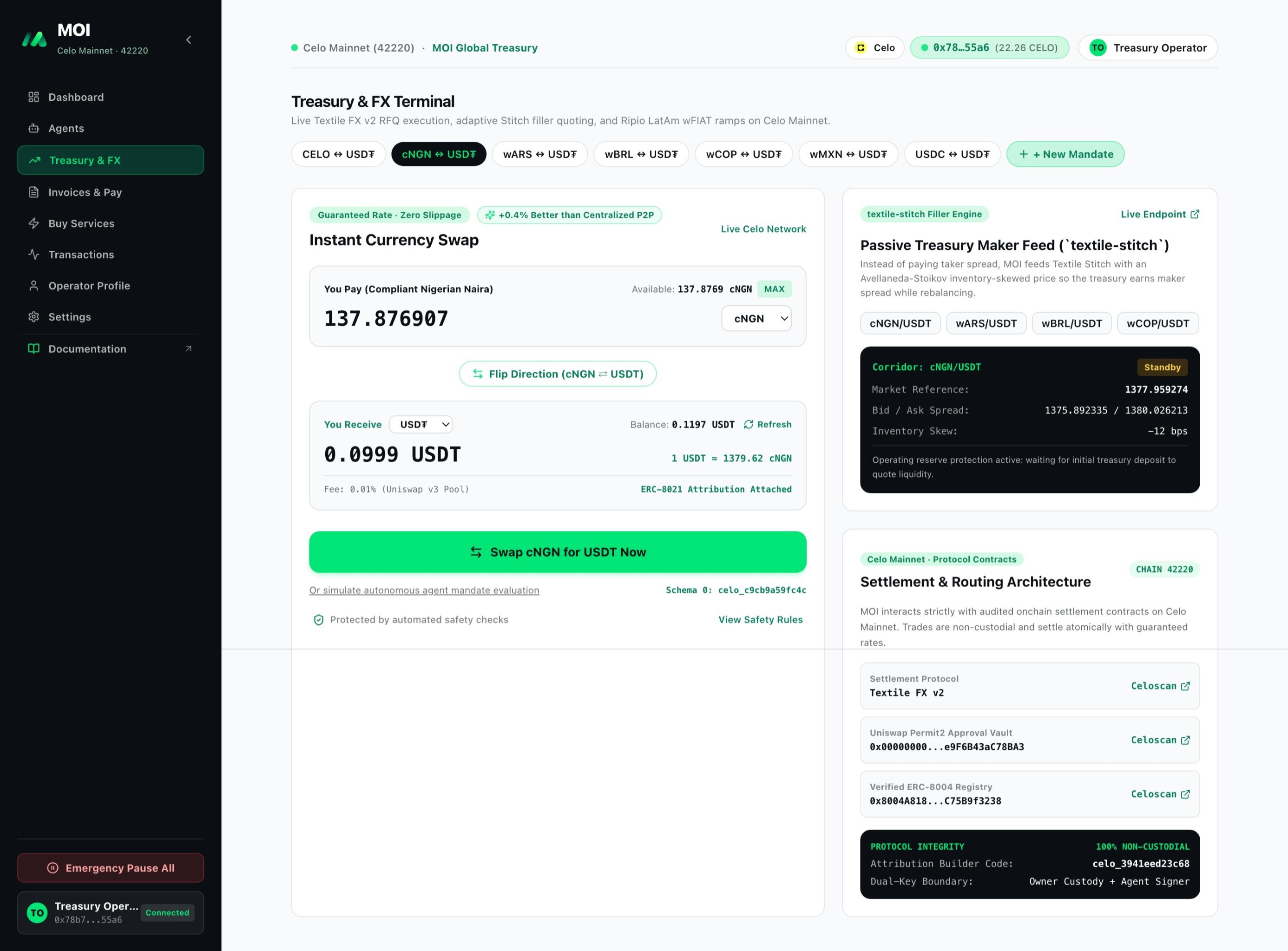
When an agent observes reserve drift against an owner's target portfolio, it drafts a transaction that must clear MOI's eighteen deterministic policy rules offchain before touching the blockchain. If any single parameter violates the mandate, the transaction is rejected instantly without gas expenditure. Once validated, MOI routes the rebalance through Textile FX v2 Request-for-Quote (RFQ) institutional liquidity on Celo Mainnet, locking in guaranteed pricing with zero slippage and sub-second settlement directly into dollar-denominated stablecoins.
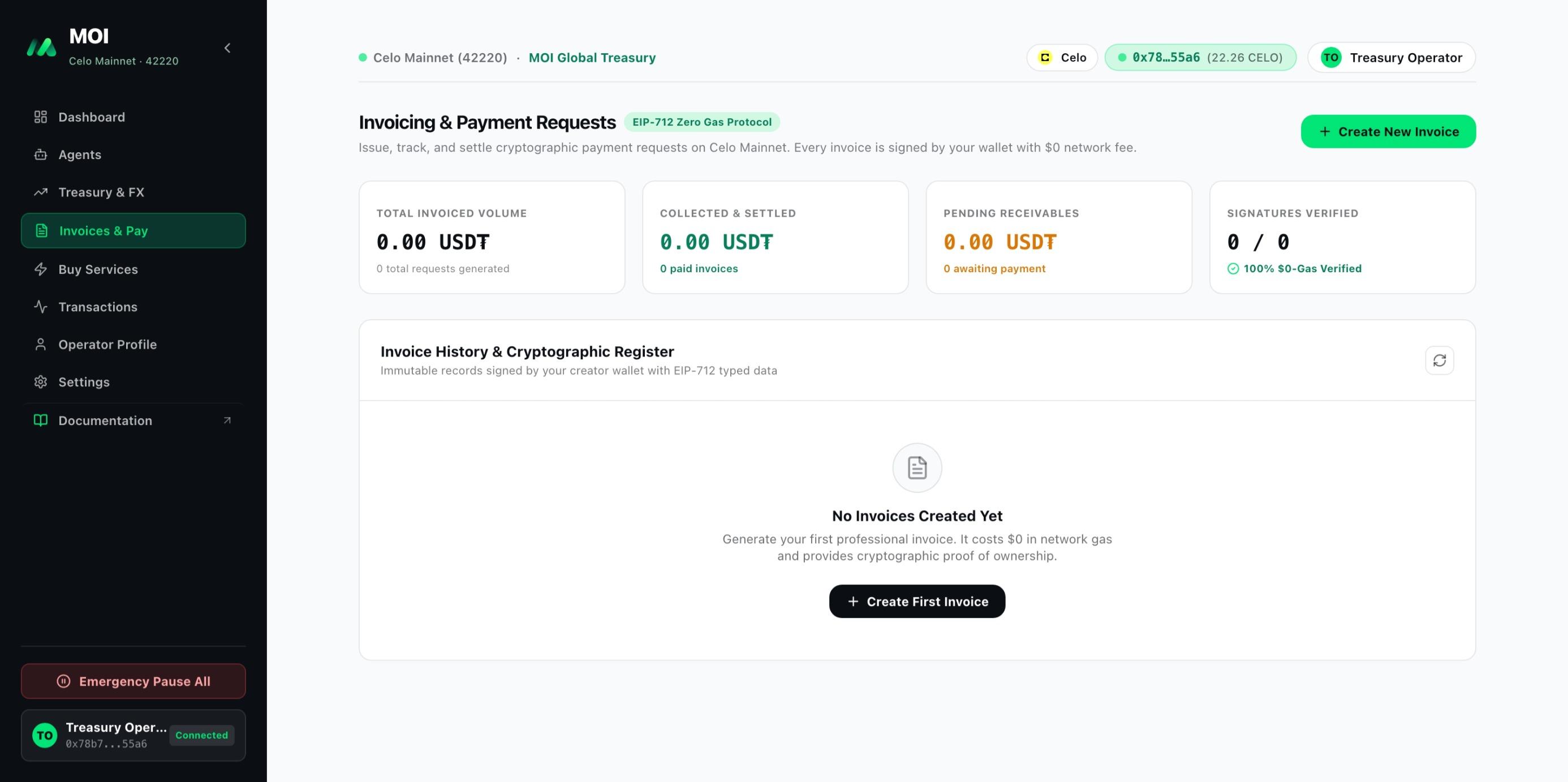
Beyond automated FX management, MOI serves as a complete financial operating system for digital businesses. It features zero-gas offchain cryptographic invoicing via EIP-712 structured data signatures with instant, scannable QR checkout, and anchors every financial action into a cryptographically verified double-entry accounting ledger where debits strictly balance credits. Every onchain transaction carries official ERC-8021 calldata attribution metadata and resolves against MOI's canonically registered identity on Celo’s ERC-8004 Agent Trust Protocol (Agent ID #164).
By replacing unrestricted agent key access with programmatic policy enforcement, MOI delivers the efficiency and speed of autonomous financial software alongside the uncompromising safety of deterministic corporate governance. It allows businesses to protect their purchasing power, automate cross-border treasury operations, and move at machine speed strictly within their rules.