 Loops House

LastMile
Connecting surplus to need, every mile of the way.

Vibeathon ’26
Links
Team
1 member- ANOwner
Anshul Datta
Overview
LastMile is a community-relief and resource-distribution website that connects three main stakeholders:
- Vendors: provide surplus food and essential supplies.
- Delivery volunteers: collect and transport donations.
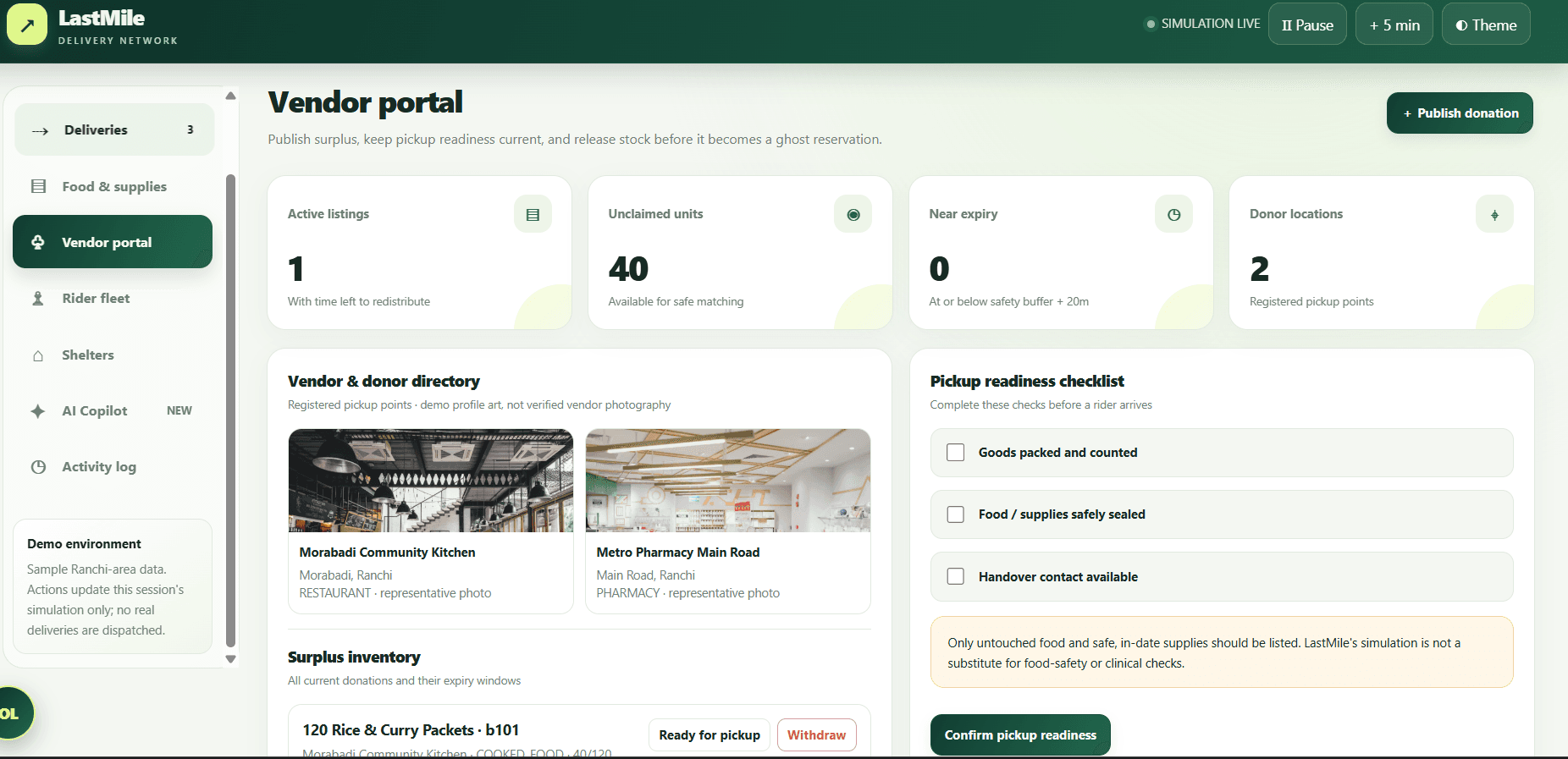
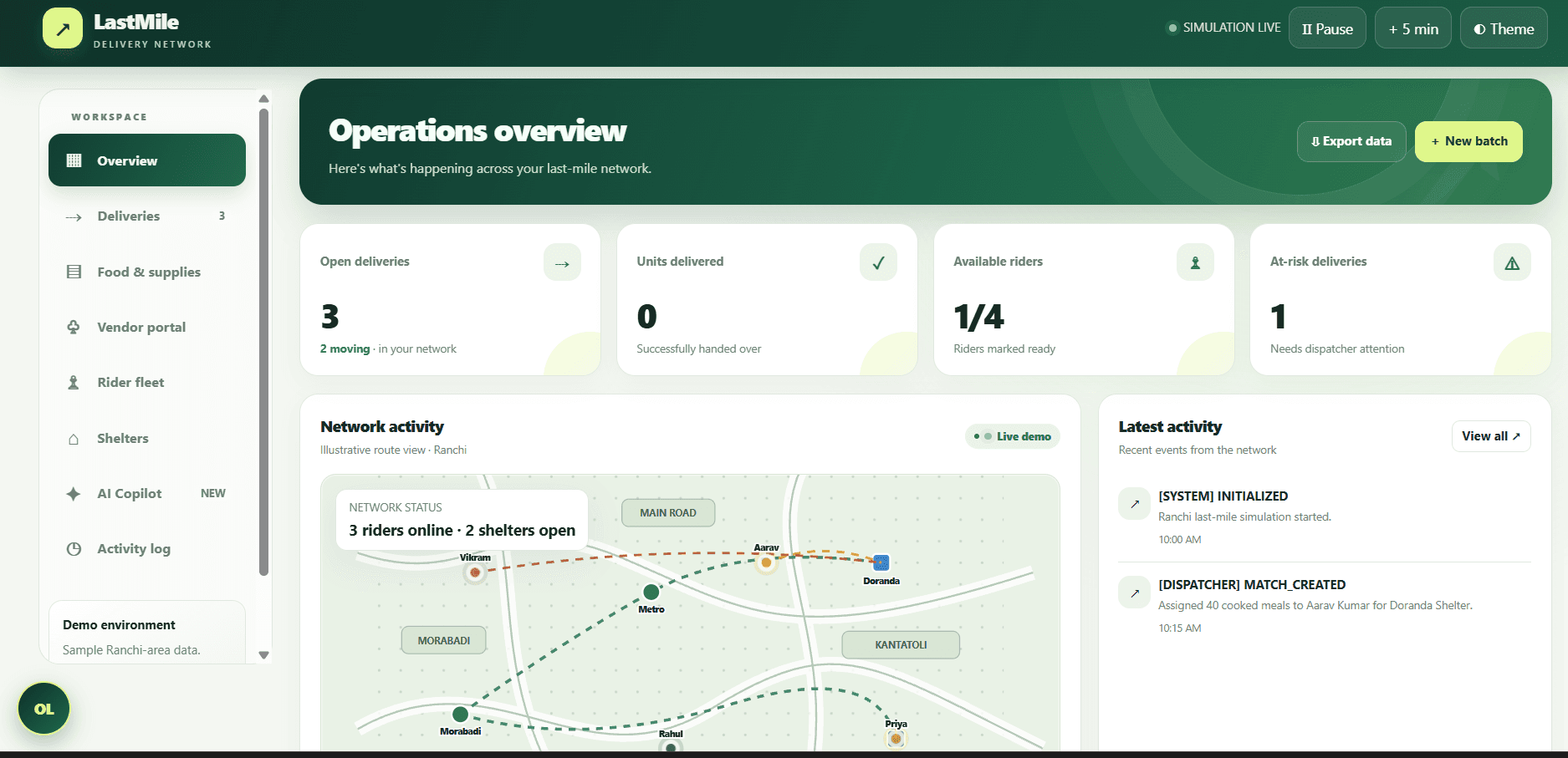
- Shelters: report their needs and confirm received resources. The main objective is to coordinate donations, transportation, demand matching, delivery monitoring, and confirmation in one platform. All website sections and their specifications Website section Main content and features Landing page Brand identity, mission statement, cinematic hero section, navigation, call-to-action buttons, animated visuals. Overview dashboard Open deliveries, units delivered, available riders, at-risk deliveries, network map, latest activity, priority deliveries. Deliveries Delivery IDs, assigned riders, destinations, quantities, deadlines, status tracking, Smart Dispatch, batch splitting, rerouting, issue reporting, delivery completion. Food & Supplies Donation batches, item categories, quantities, expiry windows, batch status, donation management, expiry-risk indicators. Rider Fleet Rider availability, transport details, carrying capacity, delivery workload, equipment capabilities, cold-chain readiness. Vendor Portal Vendor registration, vendor type, location, contact number, hygiene checks, ratings or scores, surplus inventory, donation publishing, pickup-readiness checklist. Rider Portal Rider profile, sign-in/out controls, assigned tasks, destination information, route display, simulated tracking, feedback, heartbeat monitoring, unresponsive-rider demonstration. Shelter Portal Shelter registration details, location, contact information, required products, unmet demand, receiving capacity, water/fuel/refrigeration availability, incoming deliveries, receipt confirmation. AI Copilot Network summaries, risk analysis, rider availability review, expiry and hygiene checks, shelter-demand matching, route monitoring, shift handover briefs, short-term planning. Activity Log Operational events, dispatch updates, heartbeat events, exceptions, and activity history. Theme controls Dark/light theme switching, consistent dark interface, navigation styling, responsive layout, visual status indicators.
Functional specifications Donation management
- Create and manage donation batches.
- Record resource type, quantity, pickup details, and expiry information.
- Track batch status and pickup readiness.
- Highlight donations that need urgent attention.
Delivery management
- Assign riders to deliveries.
- Display delivery statuses.
- Support rerouting, splitting, issue reporting, and completion workflows.
- Identify at-risk assignments and potential recovery actions.
Vendor management
- Maintain vendor information and pickup locations.
- Record contact details and hygiene-related information.
- Publish surplus food or supplies.
- Track availability and readiness for collection.
Rider management
- Display rider availability and assignments.
- Consider transport capacity and special equipment requirements.
- Demonstrate rider responsiveness monitoring.
- Provide a feedback and review workflow.
Shelter management
- Record shelter location and contact details.
- Maintain lists of required items and unmet quantities.
- Record receiving capacity and relevant facilities.
- Track incoming donations and confirm receipt.
Operational intelligence
- Display network-level metrics.
- Highlight expiry, delivery, and compatibility risks.
- Present AI-assisted summaries and recommended follow-up actions.
- Maintain an activity-history interface.
Technical and visual specifications Specification Current website Website format Standalone HTML website Structure A single HTML file containing the website interface Styling CSS, including theme variables, layouts, transitions, and animations Interactivity JavaScript for interface actions and dynamic behavior Default appearance Dark / midnight theme Primary colors Near-black, dark navy, and blue accents Typography Instrument Sans and Instrument Serif, loaded externally Visual effects Animated hero elements, gradients, overlays, and transitions Media External Mux video with poster image Map Map interface using external map resources; route movement is simulated Theme switching Dark and light themes Local execution Can be served using Python's built-in HTTP server External dependencies Internet access is needed for external fonts, video, and map tiles
HTML provides the structure, CSS handles presentation, and JavaScript provides interaction.
Delivery statuses and safety rules The website includes the following delivery states: Status Description CLAIMED Delivery accepted or assigned IN_TRANSIT Delivery is on the way AT_RISK Delivery needs attention DELIVERED Delivery recorded as complete RELEASED Assignment released from its previous allocation
The interface also demonstrates safety and compatibility checks, including expiry awareness, hygiene information, rider capacity, destination facilities, and cold-chain requirements.
These are supporting controls and do not replace actual food-safety inspection or professional handling procedures. Important implementation limitations For your judges, distinguish the features shown in the interface from live integrations.
- Live GPS: not connected; route and rider movement are simulated.
- AI Copilot: the current website describes an offline, state-aware assistant. Do not claim a live AI API integration without verifying it.
- Data and metrics: verify which values are sample data and which are saved or calculated from actual records.
- Backend and database: the standalone HTML interface alone does not establish that all modules share persistent server-side data.
- External services: video, fonts, and map tiles depend on external resources.
- Safety validation: displayed checks are not proof of compliance or actual food safety. Main project objective The complete workflow is designed to follow this sequence:
Vendor publishes a donation → shelter reports demand → resources are matched → rider is assigned → delivery progress is monitored → shelter confirms receipt → activity is reviewed.
The central value of LastMile is connecting the supply side, demand side, and delivery side in one coordinated system.