 Loops House

Ayo
A price feed that decides which Textile corridor is worth quoting, and turns the rest off.

Agents on Open Rails Hackathon
Team
1 member- OLOwner
Olarewaju Akeem
Overview
Textile's filler guide says the thing that decides a filler's results is its price feed: compare more than one source, your quotes are only as good as your feed. Stitch, the reference bot every operator starts from, turns that into static configuration - one feed URL, one spread, set once. Ayo is the feed instead of the configuration.
THE OBSERVATION. On 28 October the cNGN/USDT corridor on Celo traded at a 28.4bp venue spread in the morning and 0.22bp by evening - a 127x range inside one day, on the single number that decides whether quoting is profitable. Three days later the corridor paying was wBRL and IDRX had no two-sided market at all. No configured constant is right across that.
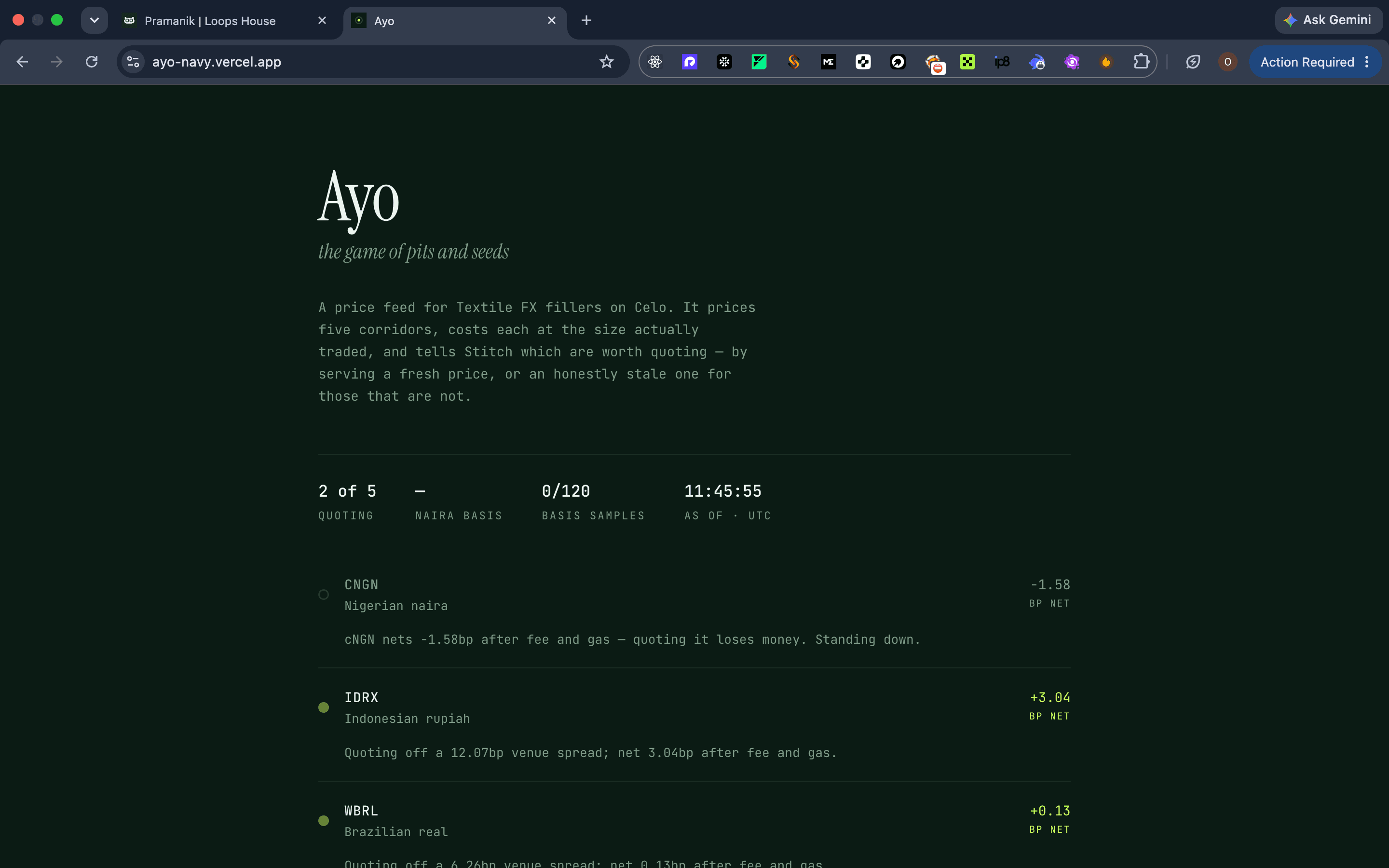
WHAT IT DOES. Ayo scans all five live Celo corridors (cNGN, IDRX, wBRL, wARS, USDC against USDT) on every poll and costs each one at the clip size actually being traded: venue spread, minus the share a filler can realistically capture, minus Textile's 1bp protocol fee, minus gas expressed as basis points of the clip. That last term is the one small books forget - half a cent of gas is 2bp on a 25 dollar fill and 5bp on a 10 dollar one, which is more than most of these corridors pay.
It then gates each corridor independently through the one lever Stitch already respects: freshness. A corridor that clears its costs gets a current timestamp and Stitch quotes it. A corridor that does not gets an honestly old one, and Stitch stands down by itself. No restart, nothing to watch. Typically one or two of the five clear their costs at any moment; the rest stand down, each with a stated reason you can read on the live endpoint.
THE NAIRA CROSS-CHECK. Mento runs an independent naira market on the same chain in NGNm. It is a different token from cNGN, and the two sit at a persistent spread - measured at roughly 420bp and stable to within a basis point over hours. So the raw gap carries no information; the deviation from its own mean carries all of it. Ayo records every observation, refuses to trust a mean before 120 samples, and stands down when the basis moves away from where it has been living. It is the one corridor where a second opinion exists, and no other filler has it.
WHY IT IS BUILT THIS WAY. Stitch handles RFQ, EIP-712 signing and settlement - proven, and theirs. Ayo supplies the judgment through the HTTP price-feed interface their own docs describe. Not a fork, not a workaround: the extension point they documented.
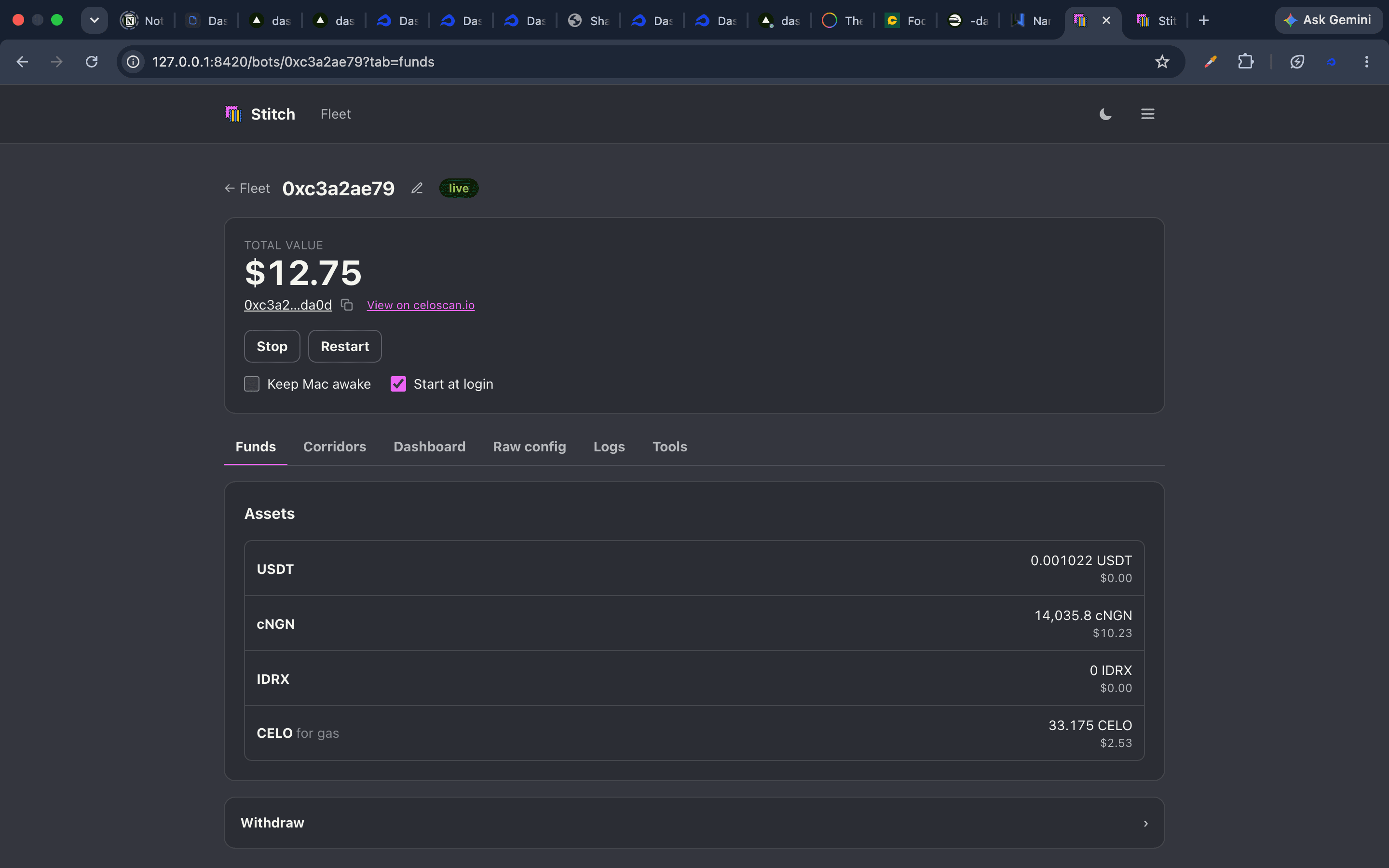
Running live on Celo mainnet from 0xc3A2AE793B4aCC88620E538201913A7F042edA0D, quoting cNGN/USDT and IDRX/USDT through Stitch.