 Loops House

AID Flow
AidFlow AI — Smart Perishable Aid Coordination Platform

Vibeathon ’26
Team
1 member- SAOwner
sarthak
Overview
AidFlow AI: project description
Zero food waste. Every minute counts.
Short description (for a submission form, about 50 words)
AidFlow AI is a real-time platform that connects food donors, volunteer riders and receiving shelters. It plans deliveries around expiry windows, rider capacity and facility compatibility. It also recovers automatically from ghost reservations, traffic delays and sudden changes in demand, so perishable food reaches people safely.
Full description (for README or GitHub) The problem
Surplus food is often wasted not because there is too little of it, but because coordination fails. A banquet hall may have 180 meals that spoil in 75 minutes, while one rider can carry only 40 and one shelter has space for 50. Riders reserve food and then go silent. A shelter’s demand gets filled while a rider is already on the way. Some supplies, such as raw rations or infant formula, are useless or harmful at a site without cooking fuel or clean water.
Our solution
AidFlow AI is a full-stack web application with three role-based portals, Donor, Receiver and Rider, all running on one backend and one database. It treats time, transport capacity, compatibility and human unreliability as live variables instead of ignoring them.
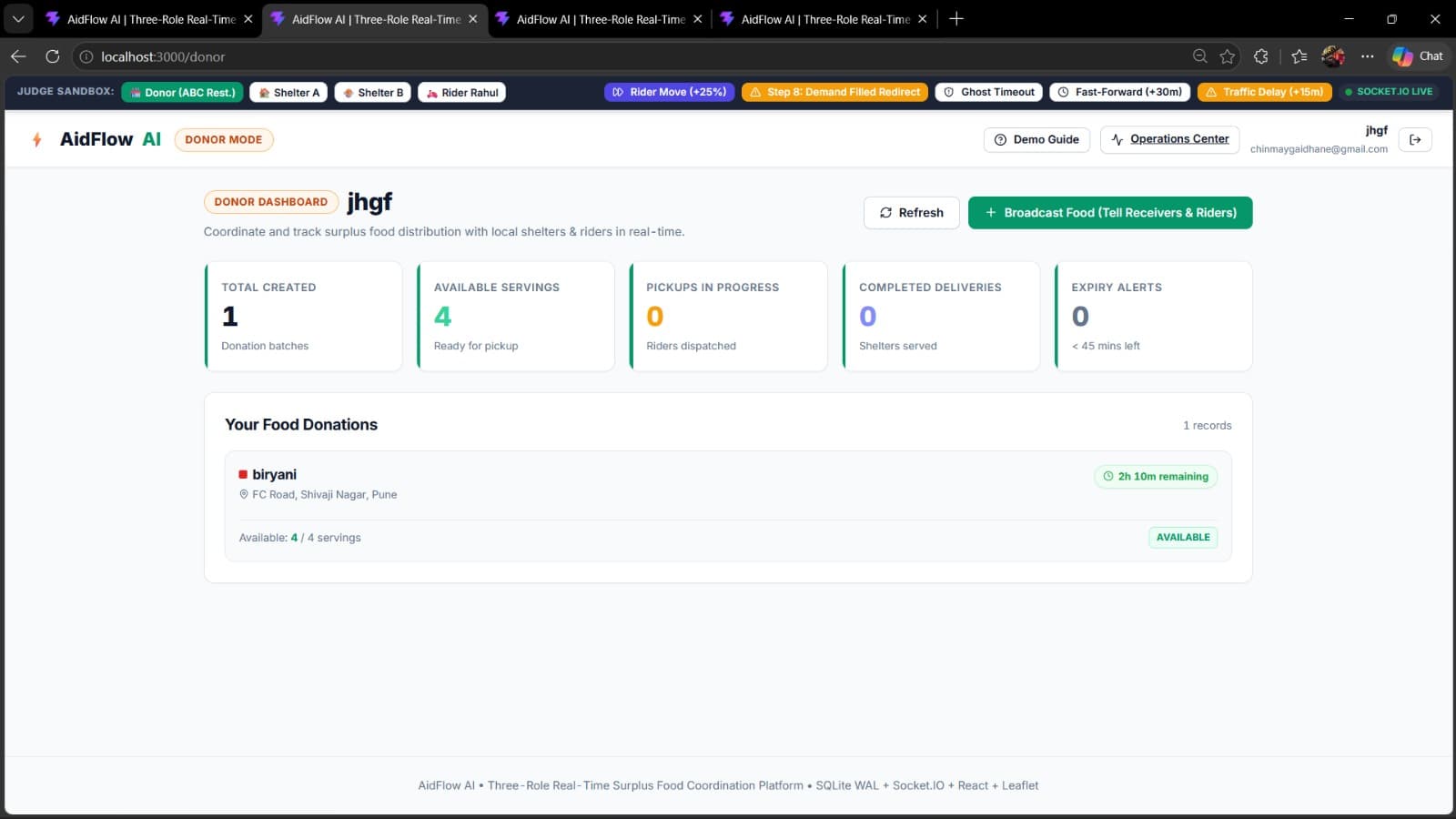
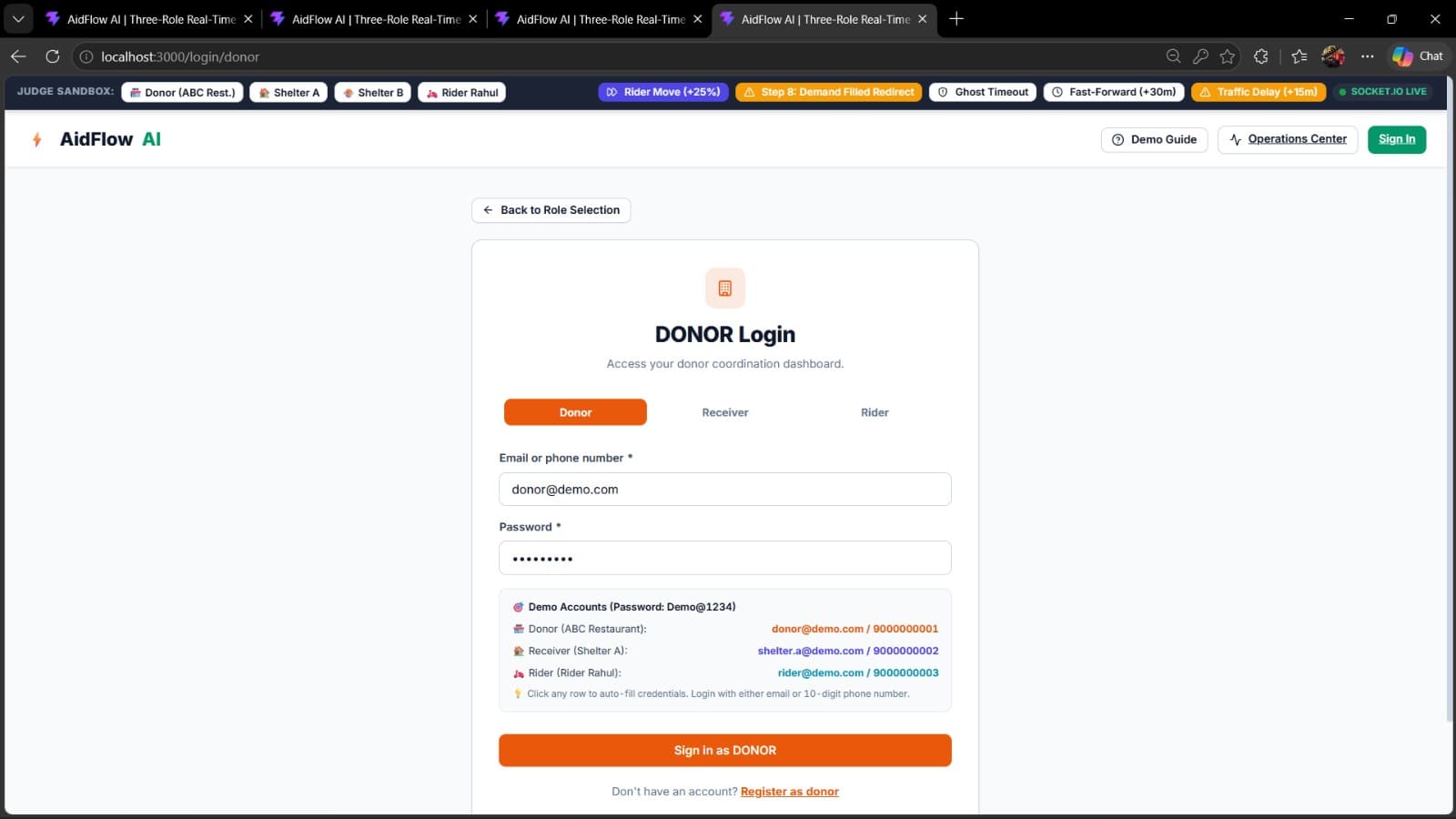
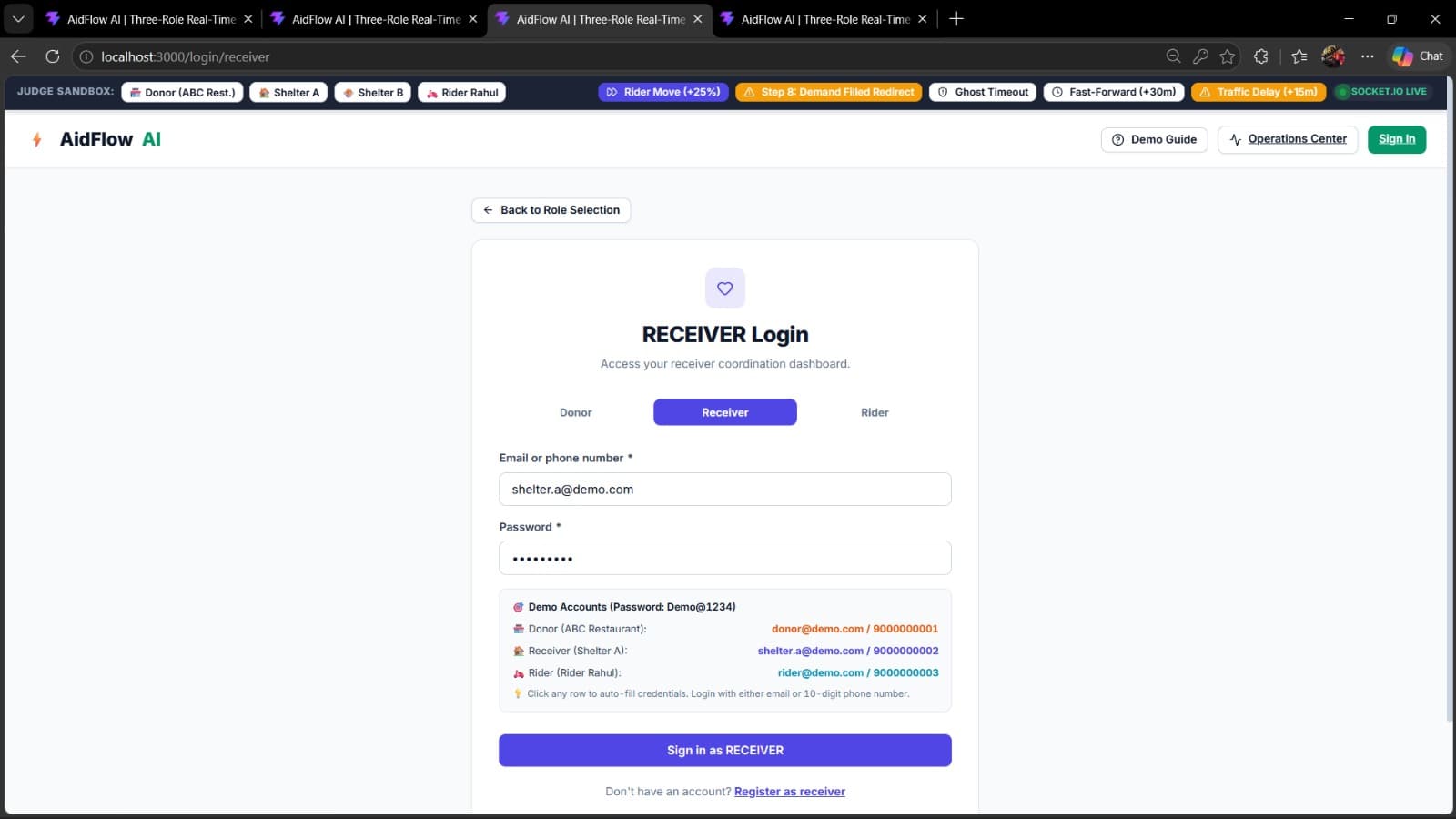
Donors list surplus food with a configurable safe-use deadline and watch each delivery on a live map. Receivers (shelters, NGOs, relief camps) see only the meals that can actually reach them before the deadline, request an exact quantity, and track the rider. Riders see only feasible assignments within their capacity, and complete pickup and delivery with verification codes. Key features Feasibility-filtered feed: meals that cannot arrive in time or are incompatible with a receiver’s facilities are hidden. No overallocation: reservations run in database transactions, so two requests cannot claim the same servings. Ghost reservation recovery: if a rider goes silent before pickup, the reservation is released, a new rider is found, and the event is logged. Cargo already picked up is never released. Delay and traffic handling: ETAs are recalculated every 30 seconds. At-risk deliveries are redirected to a reachable alternative shelter, or an urgent alert is raised. Mid-transit redirection: if a shelter’s demand is filled while a rider is on the way, the system finds another compatible shelter that can still be reached in time. Safety enforcement: unsafe or expired deliveries are blocked, and late food is never treated as safe. Handover verification codes: pickup and delivery are confirmed with codes, which prevents fake confirmations. Rider reliability score: matching favors dependable riders and shortens timeouts for unreliable ones. Live synchronization: all three dashboards update in real time through Socket.IO, and rider position comes from a single simulation service so dashboards never contradict each other. Impact dashboard: meals delivered, recoveries and failures, reported honestly. Secure authentication: login with email or phone number, hashed passwords, role-based access control and ownership checks. Tech stack
React, Vite, Tailwind CSS, Leaflet with OpenStreetMap, Node.js, Express, Socket.IO, SQLite, JWT and bcrypt.
Note on simulation
Rider movement and routes are simulated and clearly labelled as such. The design supports real GPS tracking through the browser Geolocation API as a next step.
Future scope
Real GPS tracking, SMS OTP verification, multi-donor pickup batching, a mobile app, and multilingual support such as Hindi and Marathi.
If you tell me the exact submission fields (character limits, “inspiration”, “challenges we faced”, “what we learned”), I can fit the text to each one.