 Loops House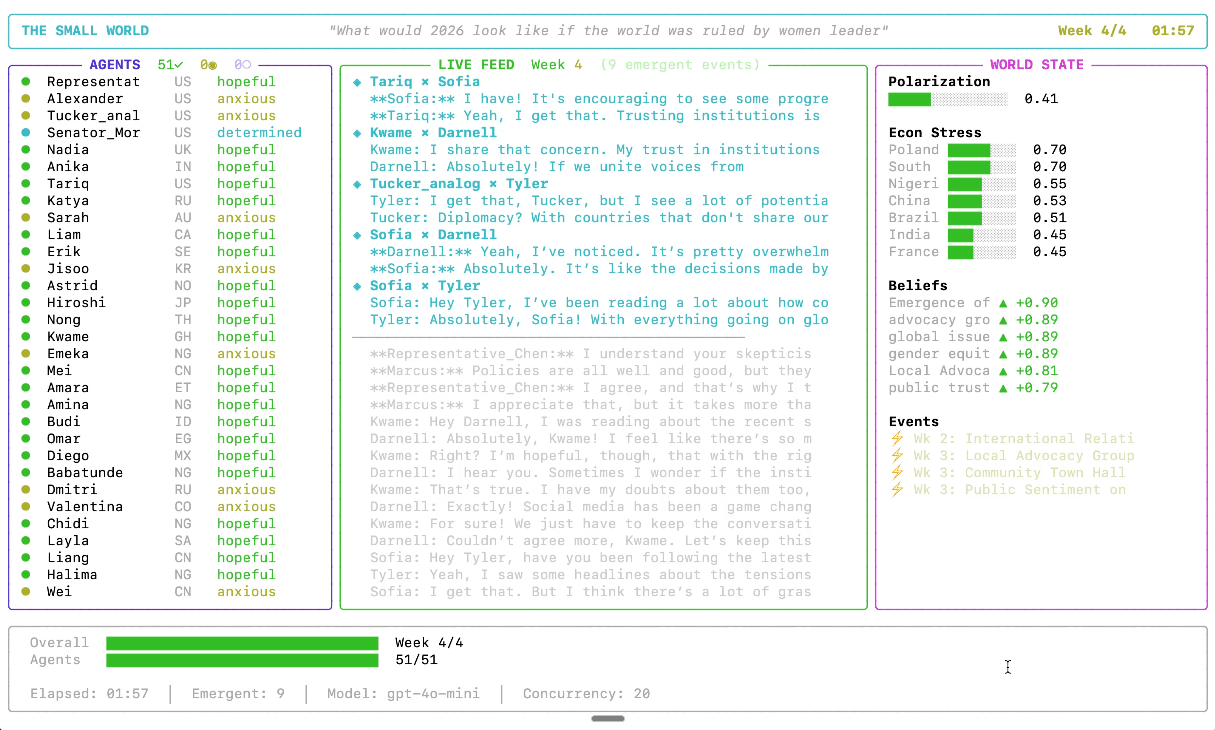
Small World
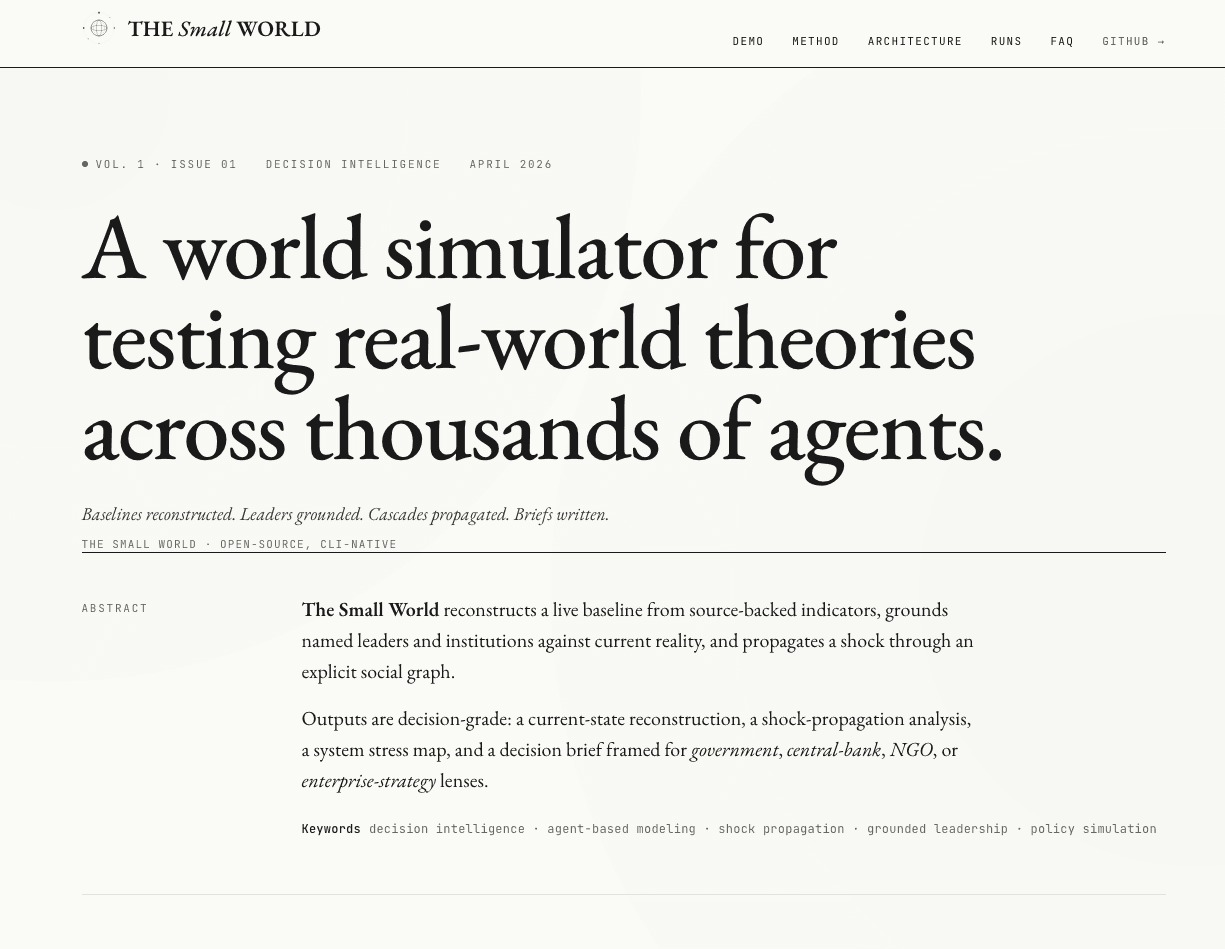
Test real-world theories on a digital society of psychologically-rich AI agents.

Agentic Loops Hackathon S1: Shanghai Edition
Team
1 member- TUOwner
Tushar Ojha
owner
Overview
Category: AI/ML
Small World is a sophisticated agent-based modeling platform designed to simulate and test real-world theories on a societal scale. The system operates on a three-stage pipeline: grounding, simulation, and presentation. Initially, the 'grounding' module constructs a baseline world state by ingesting live, real-world data to create a plausible starting point for the simulation.
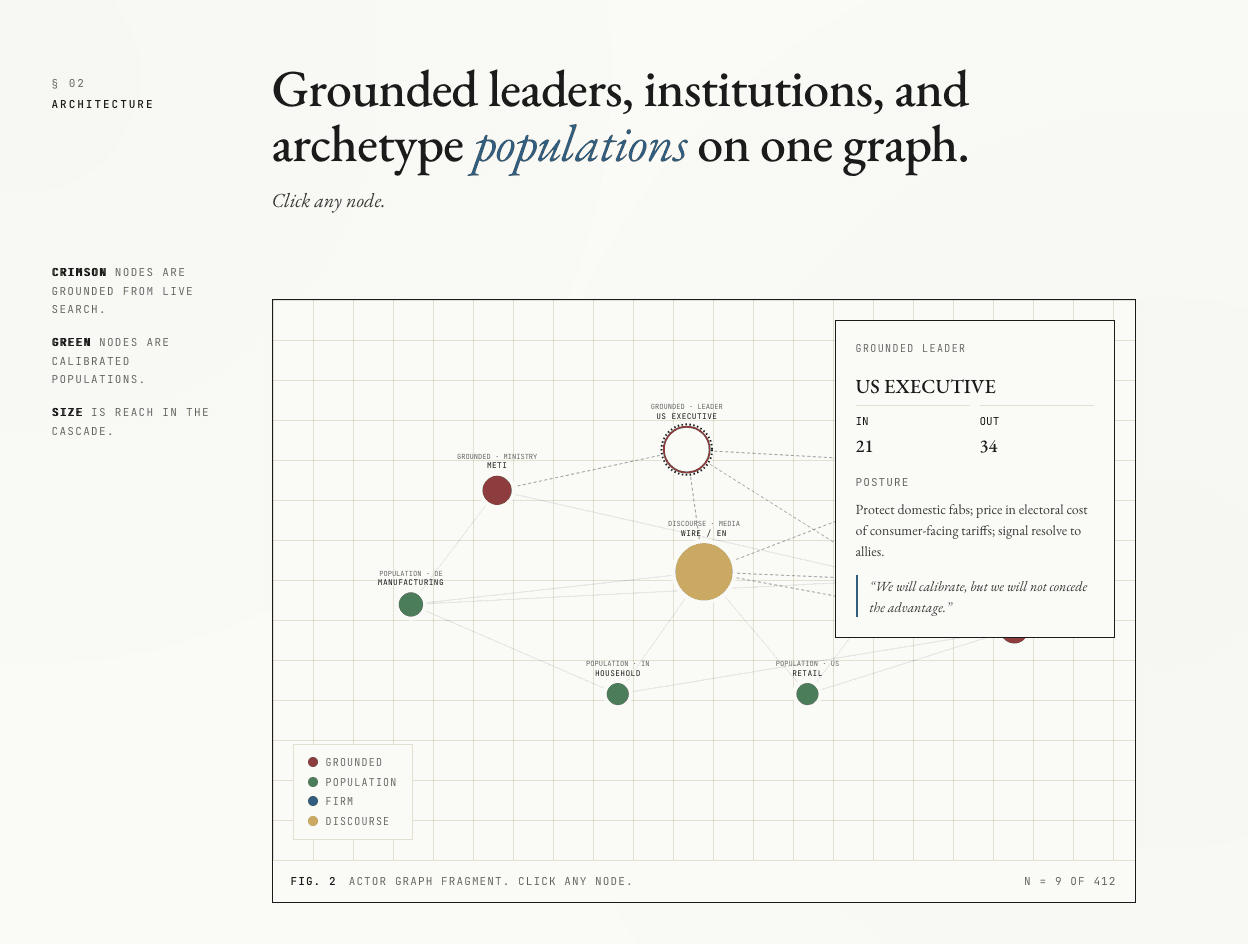
The core of the project lies in its deeply detailed AI agents. Each agent is defined by a rich AgentProfile that goes far beyond simple demographics. It includes nuanced psychographics like the Big Five personality traits, political ideology, religiosity, and trust in institutions. Crucially, it also models 'realism traits' such as media trust, political efficacy, change fatigue, and status-quo bias, allowing for more human-like behavior. These agents, each representing a weighted segment of a real population, are interconnected in a complex social graph.
Once a 'shock'—such as a new policy, economic event, or information campaign—is introduced, the simulation engine propagates its effects through the social graph. The engine tracks dynamic changes in each agent's state, including their memory, beliefs, and emotional responses. Finally, the platform synthesizes the complex results into decision-oriented outputs, automatically generating reports, slide decks (via an integrated Marp skill), and other artifacts to provide clear, actionable insights for researchers and decision-makers.
Key features:
- Rich Agent Profiling: Agents are defined by dozens of attributes, including demographics, Big Five personality traits, political ideology, media trust, and even 'change fatigue' for realistic behavior.
- Social Graph Propagation: Inject shocks or events into the world and watch their effects propagate realistically through the agents' interconnected social graph, influencing beliefs and decisions.
- Real-World Grounding: Simulations begin from a current-state baseline constructed from real-world data sources, ensuring scenarios are relevant and plausible.
- Automated Reporting: Automatically generate decision-oriented outputs from simulation results, including summary reports, slide decks, and saved world-state artifacts.
- Dynamic Agent State: Agents are not static; their memory, beliefs, and emotional states evolve throughout the simulation based on the events they experience.
- Population-Scale Simulation: Each agent archetype can represent millions of real people through a weighting system, allowing for efficient yet comprehensive simulation of entire populations.