 Loops House
Raasta
Maps show the destination. Raasta sorts the journey.

DevDay Exchange Community Metro Hackathon: Pune
Team
1 member- SHOwner
Shambhavi Patil
Overview
A woman finishes work late in Pune. It is 9:45 PM. Her plan is a bus, then the metro, then an auto home. The bus doesn’t come. The street is dark, half the shops have shut, and the few people around are leaving. She opens her map, and it still shows the same blue line it showed an hour ago. She is not lost. She is alone, and nothing is with her on the way. Raasta is built for that moment, and for every Pune commuter who depends on public transport and has no plan B.
Raasta is for all. It is for the student counting every rupee, the shift worker travelling when the network is thinnest, the parent travelling with a child, the elderly rider who needs fewer changes and less walking, the office commuter stuck at a stop with no idea when the next bus is coming, and the woman travelling home after dark. Anyone in Pune who rides a bus, the metro or an auto is who we built it for. Safety is where we start, because that is where a failed journey costs the most, but the same journey companion works for everyone.
Google Maps and Apple Maps are built to show the destination. They find the shortest or fastest route and stop there. They don’t ask whether that street is lit, whether anyone is on it, or whether anything is open. For someone travelling alone at night, the shortest route and the safest route are often not the same, and no map tells her so. Raasta is our answer. We built it so the journey itself is safe, easy and sorted, not only the destination.
What we mean by safer. For every walk or auto leg, Raasta finds two routes on the same street map: the shortest route, like a normal map app, and a safety route. The safety route weighs every street by three things.
First, crime data. Streets inside high-crime zones cost more, so the route avoids them where it reasonably can.
Second, how many people are around. Raasta estimates how busy a street is likely to be at the hour you walk it, from the shops, food places and services along it and their opening hours. A street full of open places at 6 PM can be empty at 10 PM, so the same street scores differently at different times.
Third, what is open and what is closed. It counts the places open when you pass, the late-night help points that stay open after midnight like police stations, hospitals, fuel stations and pharmacies, mapped cameras, and transit stops. It also finds dark gaps, which are stretches of side street with nothing open, nothing watched and no stop nearby. It shows the longest dark stretch on every route, so you can see, for example, 67 metres against 300 metres, and choose with your eyes open.
All of this is combined into one safety score for each route. The safety route never goes more than 40 percent longer than the shortest, so safety never means an unreasonable detour. In this prototype the crime layer is demo data, built to take real police data when it becomes available, and the people and open-place data comes from OpenStreetMap.
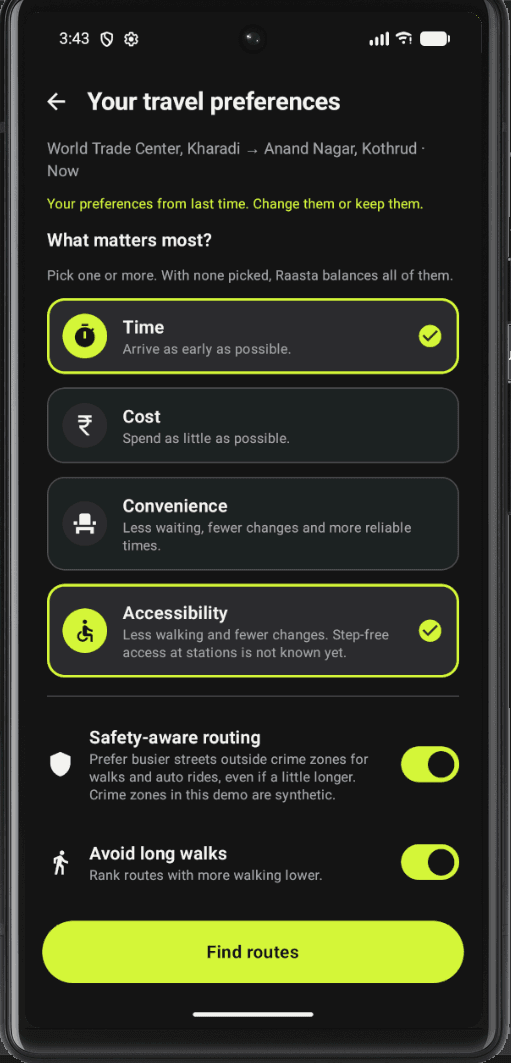
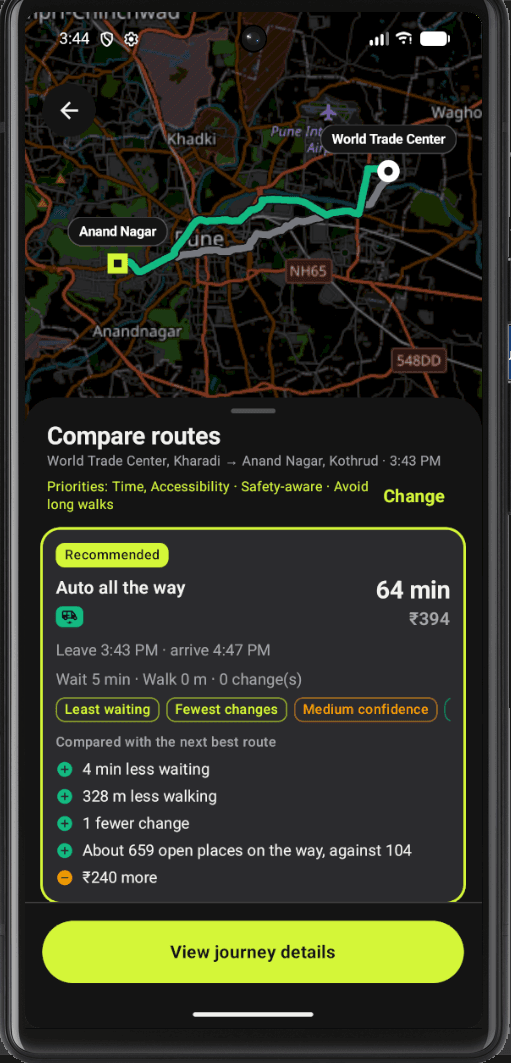
You also tell Raasta what matters to you. You choose any mix of four inputs: time, cost, convenience and accessibility. Time means arrive as early as possible. Cost means spend as little as possible. Convenience means less waiting, fewer changes and more reliable times. Accessibility means less walking and fewer changes. A student can pick cost. A parent with a child can pick convenience. An elderly rider can pick accessibility. You can also switch on safety-aware routing and avoid long walks, and Raasta remembers your choices for next time. It then ranks bus plus metro, auto plus metro and auto-only routes on that mix, using real Pune fares from the Pune Metro fare chart, PMPML distance slabs and the Pune auto tariff with its night surcharge.
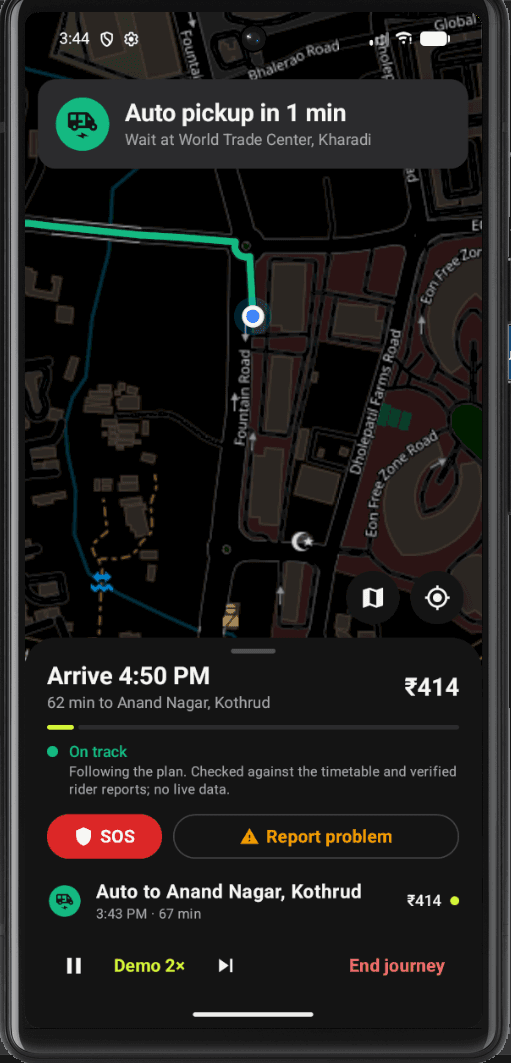
When the journey breaks, Raasta stays with you. If your bus doesn’t come, you tap one button and Raasta re-plans from where you are. It keeps your preferences and compares every option with your original plan, on arrival time and total fare including what you have already paid. It tells you plainly, for example, don’t wait for bus 235, an auto gets you there 19 minutes sooner for 263 rupees more. You decide in seconds, instead of waiting alone at a dark stop wondering.
An SOS button stays on the live trip screen. One tap dials 112 or the women’s helpline 1091, shares your trip and location, and shows the nearest open place you can walk to.
Before you commit to a route, Raasta also shows what its ranking rests on. Every input is marked checked, estimate, unknown or possibly outdated, with its source and date, so it never claims more certainty than it has.
Pune runs on public transport, and Raasta is for everyone who rides it. The people who pay the most when it fails are the ones travelling alone, late, with no car, no spare money and no one to call. Maps show the destination. Raasta makes the journey safe, easy, sorted.