Back
Explore EventsExplore ProjectsMy Projects
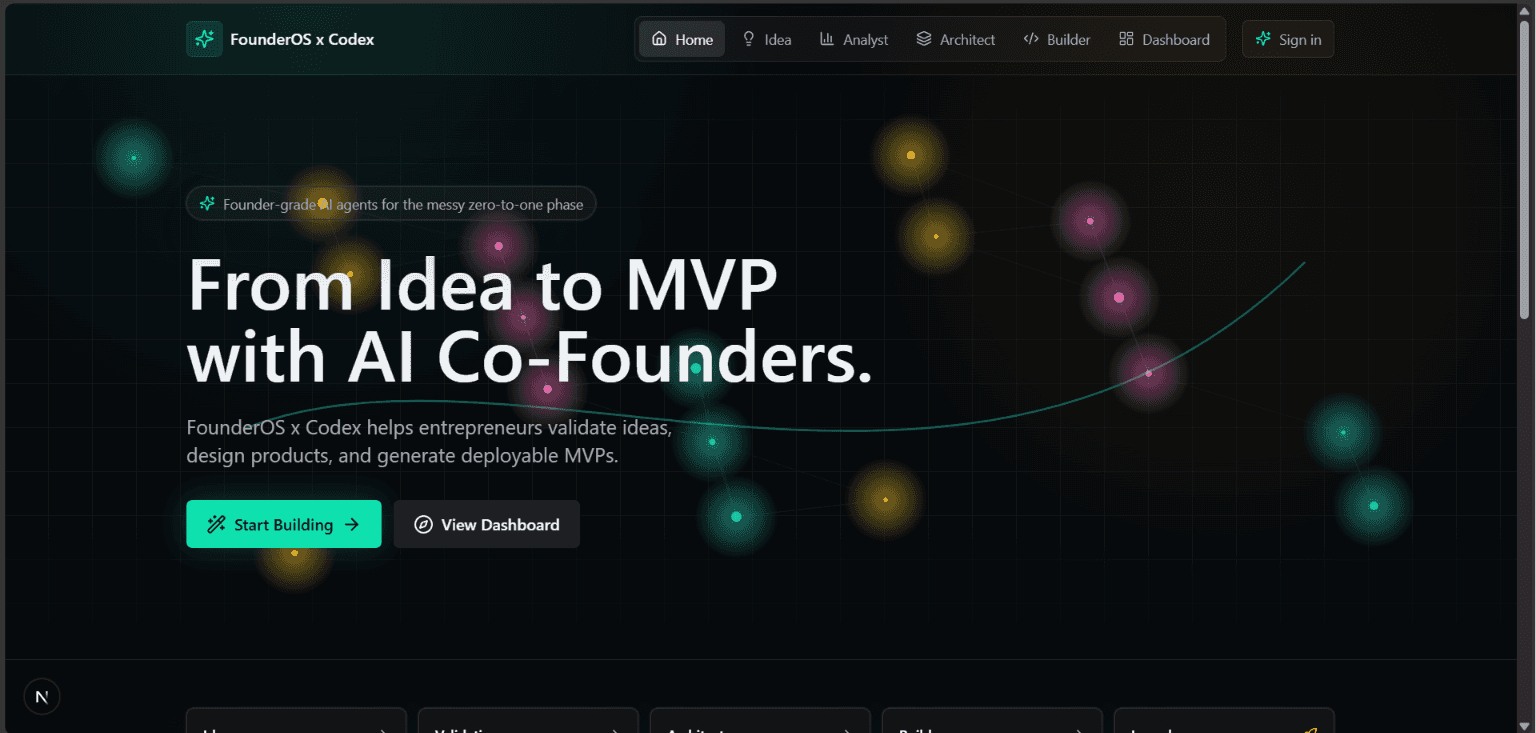
Founder OS — screenshot 1
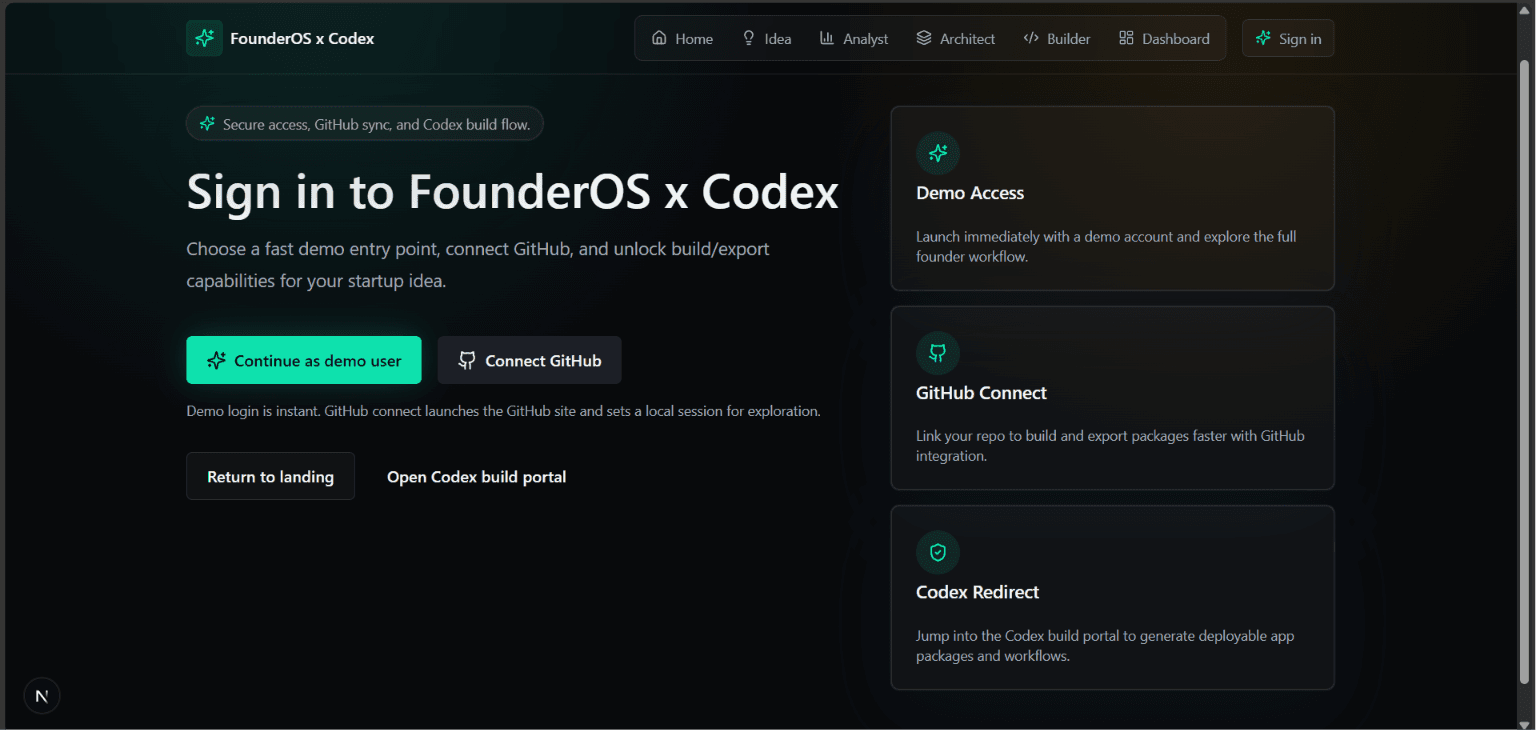
Founder OS — screenshot 2
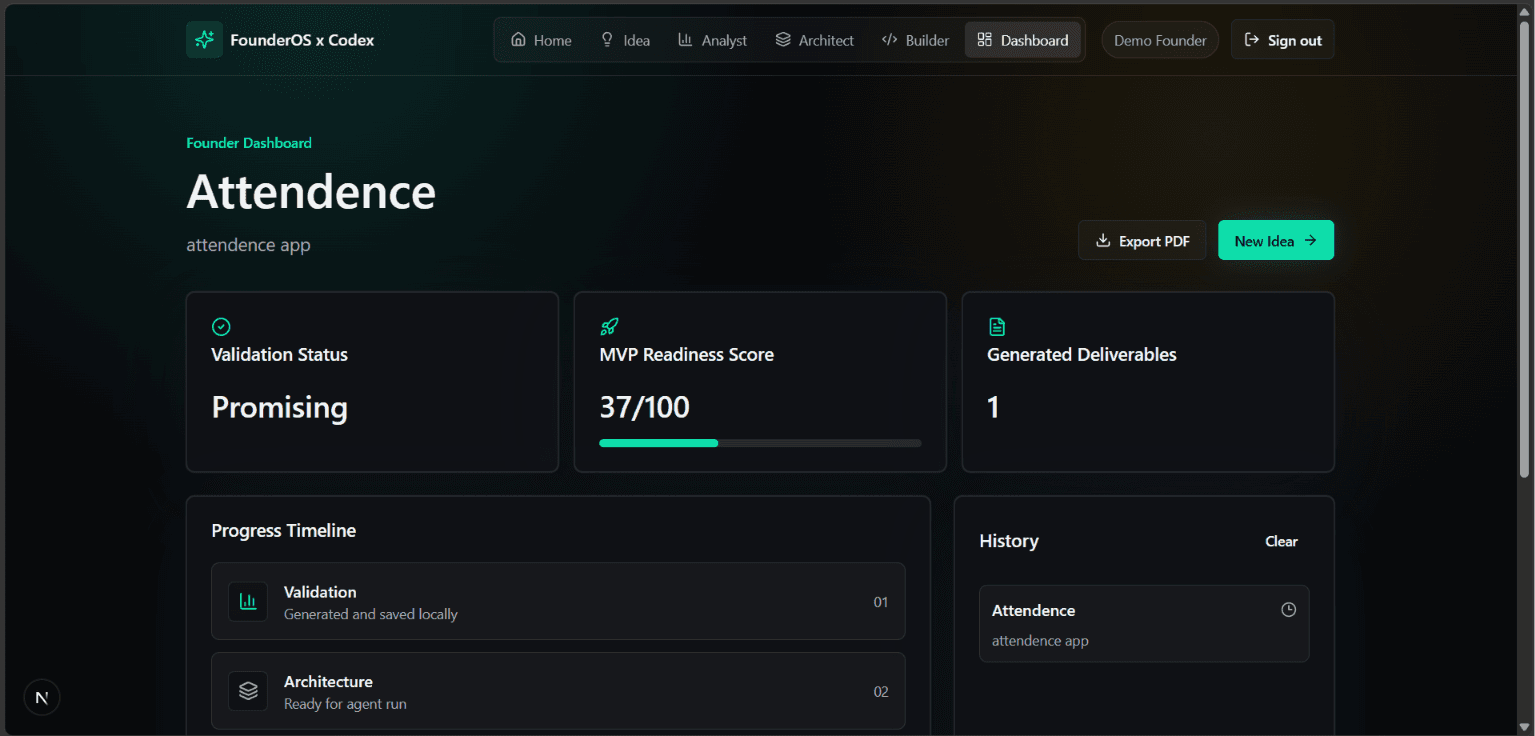
Founder OS — screenshot 3

Founder OS

Turn any startup idea into a validated business, working MVP, growth strategy, and investor-ready company using autonomous AI agents powered by OpenAI.
Codex Community Hackathon - Pune

Links

Repository

github.com/iaminnovator-07/founderos.git

Website

Not set

Demo video

drive.google.com/file/d/1LfgPhNcdt9A2f_amr-5P2mMVvW_IxKXZ/view?usp=drivesdk

Additional info

How was your experience building with Codex?

I've been using Codex even before this hackathon, so participating in the Codex Community Hackathon felt like a great opportunity to push its capabilities further and explore how far autonomous AI-assisted development can go. What impressed me most is how Codex helps bridge the gap between ideas and execution. Throughout the development of FounderOS, it accelerated everything from architecture planning and code generation to debugging, workflow design, and rapid iteration. Rather than using it as a simple coding assistant, I focused on leveraging Codex as a collaborative development partner capable of handling complex tasks and helping translate product vision into working software. This hackathon allowed me to experiment with more advanced workflows, agent-based systems, and AI-driven product development while deepening my understanding of how Codex can be integrated into real-world applications. The experience reinforced my belief that AI will play a significant role in the future of software development, entrepreneurship, and startup execution. Overall, the hackathon was an excellent opportunity to enhance my existing experience with Codex, challenge my assumptions, and build something ambitious that showcases the potential of AI-powered development.

Describe your experience using Loops House as the hackathon platform. What worked well, what challenges (if any) did you face, and what improvements would you like to see?

My experience with Loops House was smooth and intuitive overall. The platform made it easy to manage submissions, track progress, and participate in the hackathon without unnecessary complexity. The submission flow was straightforward, and the interface helped participants stay focused on building rather than navigating the platform. One thing that worked particularly well was the centralized experience for registration, project submission, and hackathon updates. This reduced friction and made collaboration easier. The main challenge I faced was that some project details and submission requirements could have been surfaced more prominently, especially during the final submission phase when participants are focused on shipping their projects. More visibility into judging criteria, submission completeness checks, and project status tracking would be valuable. For future improvements, I'd love to see richer project showcases, integrated team collaboration features, submission validation before final submission, and a more interactive participant dashboard that highlights deadlines, announcements, and judging milestones in real time.

Tell us about your overall experience at Codex Community Hackathon Pune.

The Codex Community Hackathon Pune was an incredible experience. It brought together builders, founders, developers, and AI enthusiasts who were genuinely excited about exploring the future of AI-powered software development. The sessions, networking opportunities, and exposure to OpenAI's latest tools were highly valuable. One of the highlights was interacting with like-minded participants and seeing the diverse range of ideas being built using Codex. The event created an environment that encouraged experimentation, rapid prototyping, and ambitious thinking. As someone who had already been exploring Codex before the hackathon, this event gave me the opportunity to deepen my understanding of its capabilities and push myself to build something much more ambitious. It reinforced my belief that AI will significantly change how products and startups are built in the coming years. Overall, the event was well-organized, inspiring, and highly rewarding for anyone interested in AI, entrepreneurship, and software development.

What could Codex Community improve to create a better experience for participants?

The experience was already strong, but there are a few areas that could make future editions even better. More hands-on workshops focused on advanced Codex workflows, agent orchestration, and production-scale AI applications would be extremely valuable. Many participants understand the basics but would benefit from deeper technical guidance on building real-world systems. It would also be helpful to provide additional mentorship touchpoints throughout the hackathon, allowing teams to validate ideas, architecture decisions, and implementation approaches with experienced mentors. Another improvement could be creating more opportunities for participant interaction, such as team-matching sessions, startup showcases, lightning demos, and networking activities. This would help participants learn from one another and build stronger connections within the community. Overall, the foundation is excellent, and with more technical deep-dives, mentorship, and community engagement opportunities, the experience could become even more impactful for future participants.

Team

1 member
  • SW

    Swadeep Bansode

    Owner

Overview

FounderOS is an AI-native startup operating system that helps founders go from idea to execution. Instead of using separate tools for market research, customer discovery, product planning, development, growth, and fundraising, FounderOS orchestrates a team of specialized AI agents that work together throughout the startup lifecycle.

A founder simply enters an idea, and the platform automatically validates the opportunity, identifies target customers, designs the MVP, generates technical architecture, builds production-ready code using OpenAI-powered workflows, creates launch strategies, and prepares investor materials.

FounderOS combines startup expertise, AI orchestration, memory, and execution into a single platform, allowing founders to focus on vision while their AI co-founder team handles the heavy lifting.

ExploreProjectsMine