 Loops House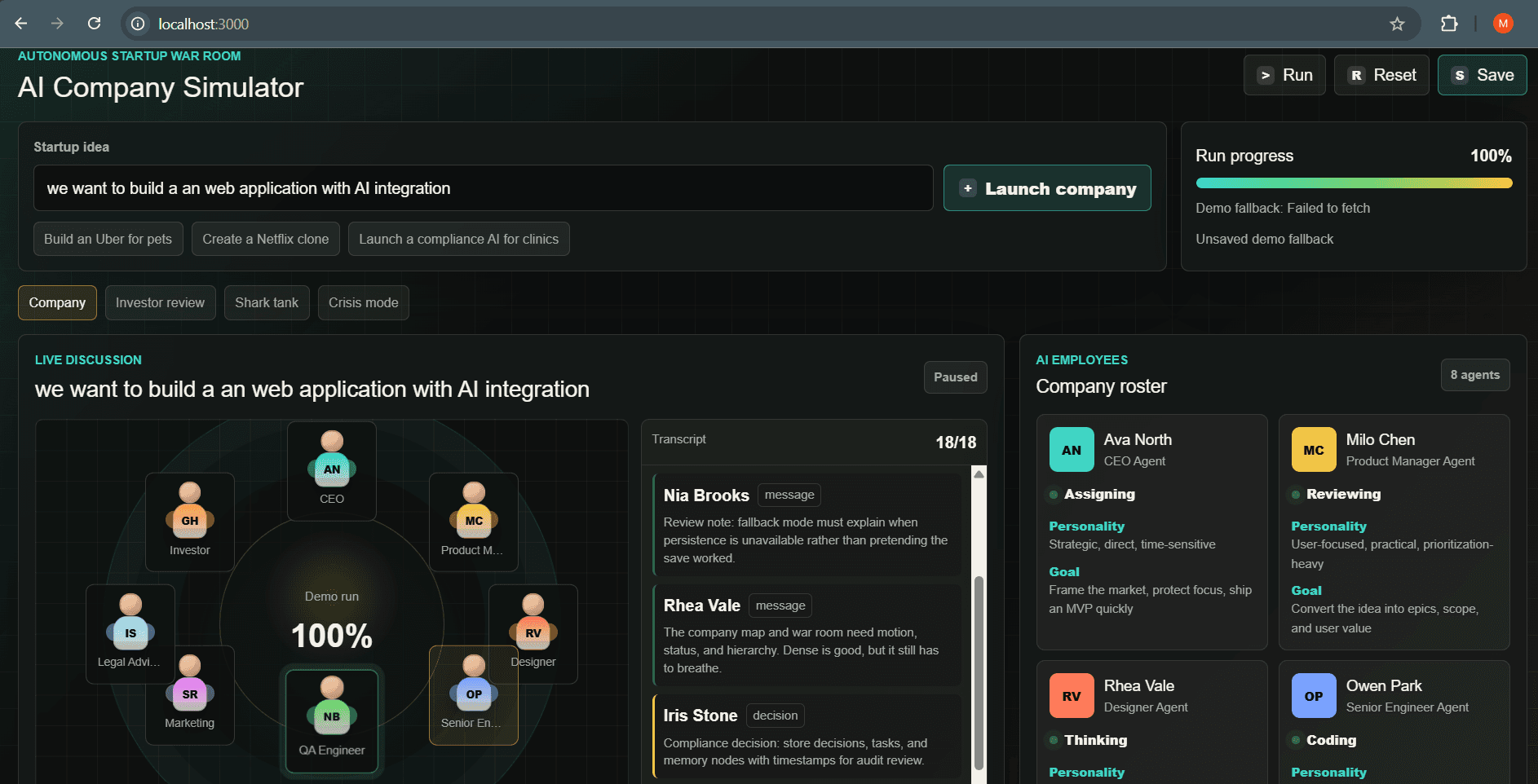
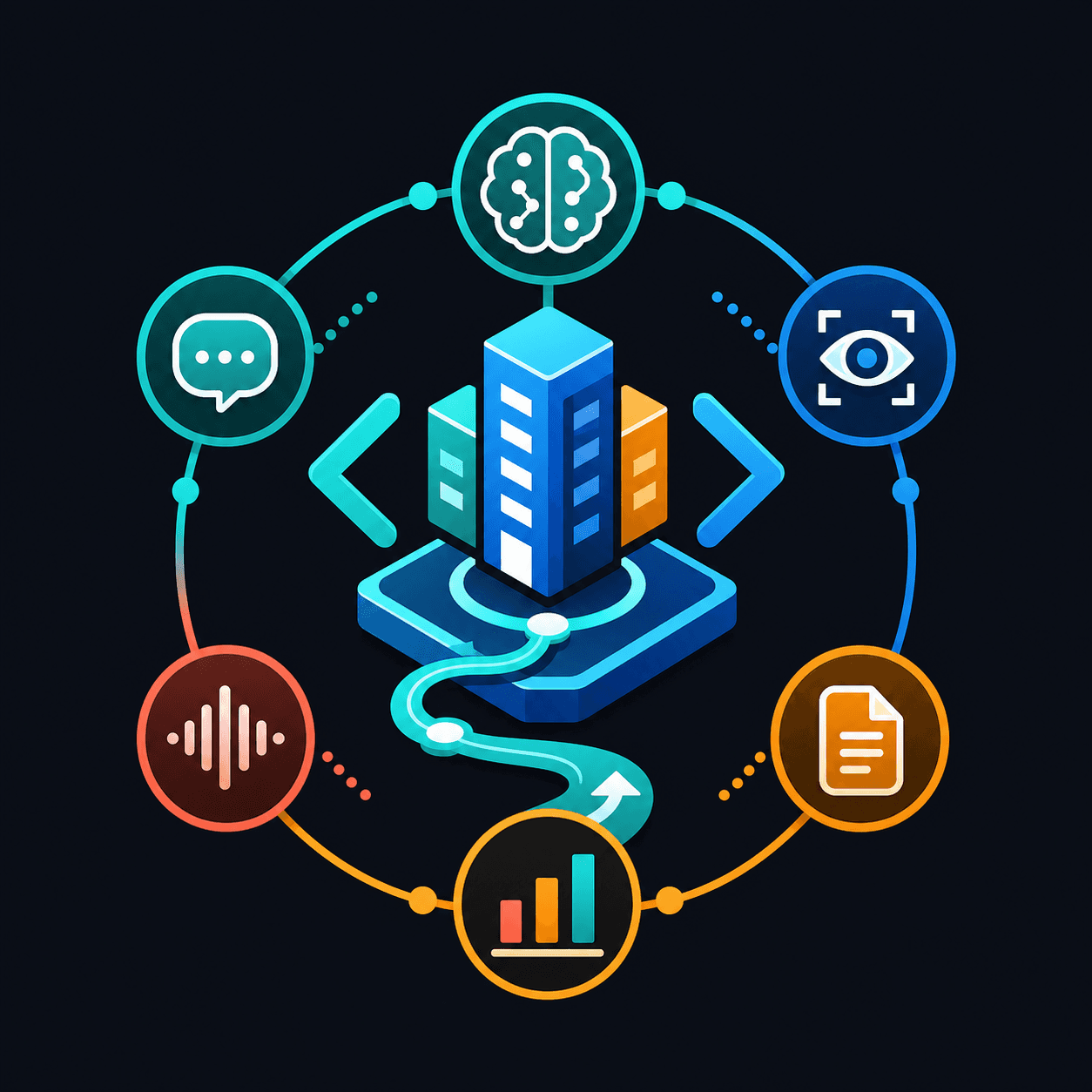
AI Company Simulator
A live AI company that designs, debates, codes, evaluates, and ships your startup idea.
Codex Community Hackathon - Pune
Links
Team
1 member- MUOwner
Muzammil Mulla
Overview
AI Company Simulator is an agentic AI application that turns any startup idea into a live, interactive virtual company. Instead of using AI as a single chatbot that gives one static answer, this project explores what happens when multiple specialized AI agents work together like a real startup team. The user enters a business idea, and the system generates a full company simulation with domain agents, live discussions, product planning, task execution, coding activity, memory, evaluation signals, and pitch-ready outputs.
The main goal of this project is to demonstrate the future of AI-native software: applications where AI is not hidden behind one input box, but presented as an active team that can reason, debate, design, code, evaluate, and help move an idea toward execution. This directly connects with the core hackathon themes: agentic coding, UX for agentic applications, multimodal intelligence, domain-specific agents, and evaluation-driven AI systems.
At the center of the product is a virtual company made of domain agents. These include a CEO, Product Manager, Designer, Engineer, QA Agent, Marketing Agent, Legal Agent, Investor Agent, and Supervisor. Each agent has a defined role, personality, expertise, goals, and memory. This makes the simulation more realistic because every agent approaches the startup idea from a different perspective. For example, the CEO thinks about vision and business strategy, the Product Manager breaks the idea into features, the Designer focuses on user experience, the Engineer thinks about implementation, QA identifies risks, Legal checks constraints, Marketing thinks about positioning, and the Investor evaluates business potential.
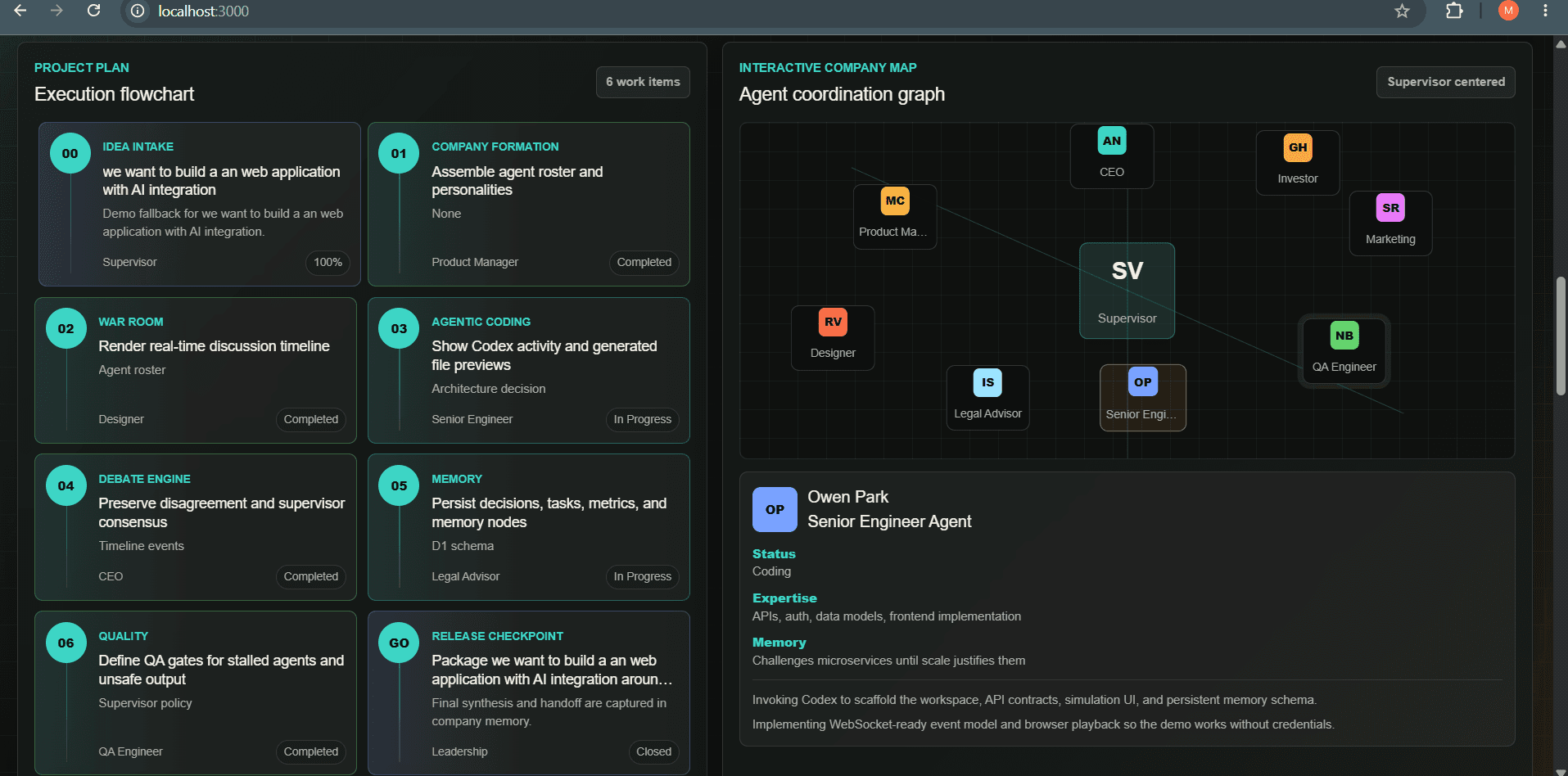
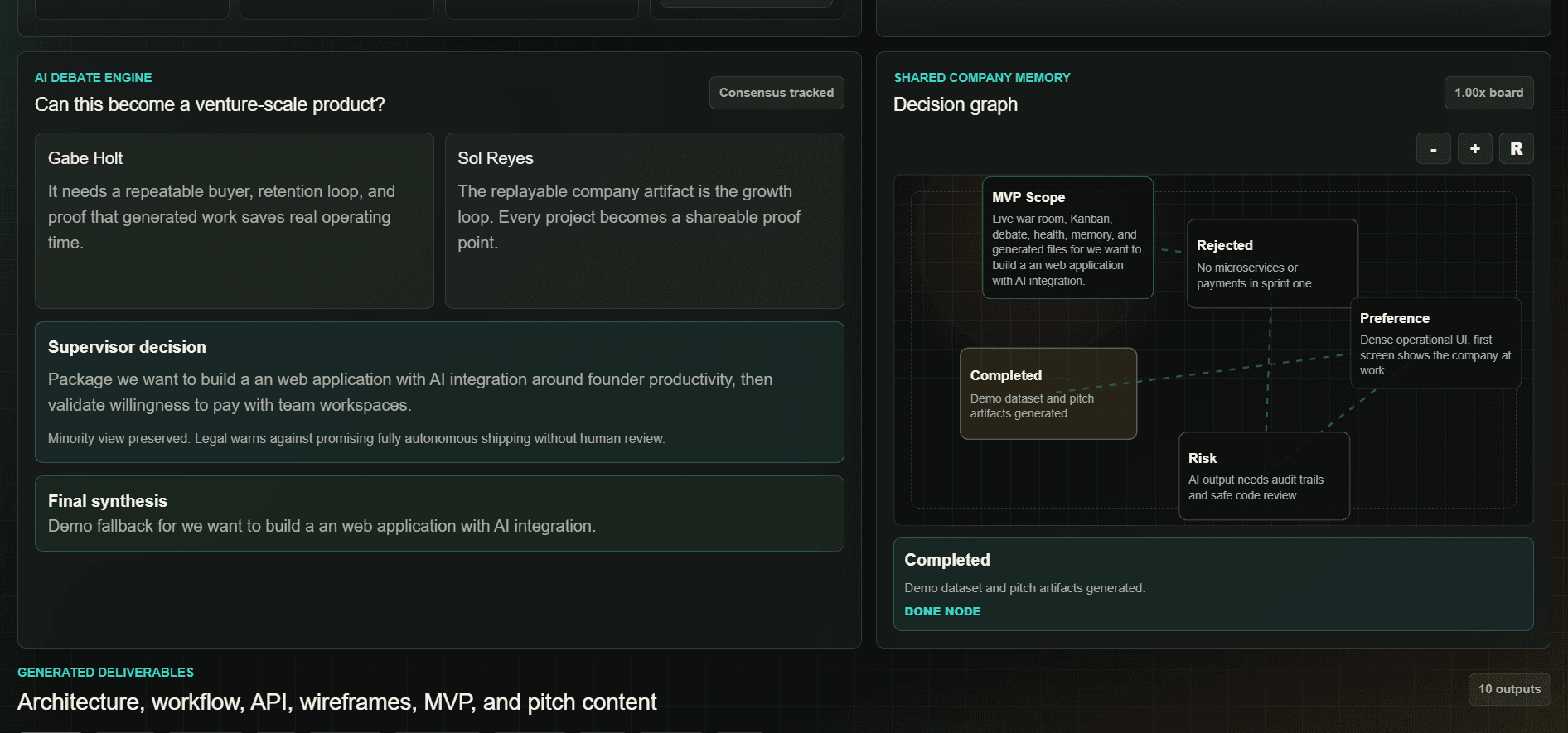
A major part of the project is the UX for agentic applications. Most AI tools today feel like simple chat interfaces, but multi-agent systems need a richer interface because there are many moving parts. AI Company Simulator visualizes the AI process through a live meeting room, transcript, agent coordination map, Kanban board, memory graph, generated files, deliverable tabs, and evaluation bars. This helps the user understand what the AI system is doing, which agent is contributing, what decisions are being made, and how the plan is evolving. The focus is not only on generating an answer, but on making the reasoning process visible and interactive.
Agentic coding is another important part of the project. The Engineer agent does not just talk about the idea at a high level. The simulator shows coding activity, generated files, architecture direction, implementation steps, and technical decisions. This demonstrates how an AI agent can participate in the software-building workflow by moving from product discussion to technical execution. It shows a bridge between ideation and implementation, which is one of the most powerful use cases for Codex and agentic developer tools.
The project also includes multimodal intelligence in the broader product sense. The system combines different types of outputs and reasoning modes: strategic discussion, product planning, UX thinking, technical architecture, code artifacts, memory graphs, investor scoring, task boards, pitch content, and evaluation metrics. Instead of producing only text, the app organizes intelligence into visual, structured, and interactive layers. This makes the output easier to inspect, demo, and use.
Evaluation is represented through live performance and contribution bars. These eval bars are important because agentic systems need observability. When multiple AI agents collaborate, users need ways to understand quality, contribution, progress, and confidence. The evaluation layer helps communicate that the system is not just generating content blindly, but can expose measurable signals about agent performance and product readiness.
Technically, the project is built as a production-ready web application using Next.js, React, TypeScript, and the OpenAI Responses API. The app includes a structured API route that asks OpenAI to generate a complete company run in a strict schema, including agents, events, tasks, debates, generated files, investor scores, memory nodes, and artifacts. It also includes fallback demo data so the experience remains usable even when generation is unavailable. The project was committed to GitHub and deployed live on Vercel.
What we achieved is a working MVP that demonstrates a full agentic product experience. A user can enter an idea, launch a virtual company, watch agents debate, inspect the transcript, view the execution flow, drag tasks on a Kanban board, explore memory nodes, review generated technical artifacts, and understand agent performance through eval bars. The product is demo-ready and shows a clear direction for how AI applications can become more collaborative, visual, and execution-focused.
In summary, AI Company Simulator is not just a startup idea generator. It is a prototype for an AI-native operating system for building companies. It shows how domain agents, agentic coding, multimodal outputs, UX design, memory, and evaluations can come together in one cohesive experience. The project highlights the future of software where users do not simply ask AI for answers, but work with an intelligent team that can think, build, critique, and ship alongside them.